When to Double Down in Blackjack: The Hands Worth Twice Your Bet
You’ve been dealt a total of 11. Just one face card, and you have blackjack. The dealer turns over a 6. Bad luck for them, but you’re on fire. This is the kind of hand that makes you pause for a second. Should you double down and capitalize on a likely win?
Some blackjack hands are practically begging for it, like the example above. Others might look tempting but are more likely to waste the extra wager. Knowing the difference, and when to take and when not to take advantage, lowers the house edge to rock bottom.
In this guide, you’ll learn when to double down in blackjack, which starting hands are worth the extra bet, and which ones are better played another way.
We’ll also cover the table rules that can change the correct play, including whether doubling is allowed after splitting, since not every blackjack table follows the same rules.
What Doubling Down Actually Means
You know it’s a move you make when you have an excellent hand, but what does double down mean in blackjack, exactly?
To double down in blackjack, you increase your original wager by placing a second bet of the same amount. Then, you receive exactly one more card and stand.
You can do the double down only after you receive your first two cards, but before you’ve made another move.
Once the third card hits the felt, there are no extra hits, even if that final card leaves plenty of room for improvement. That’s the trade of the blackjack double down. You risk twice as much money for the opportunity to capitalize on a strong starting hand.
It’s a simple concept, but you’ll need to be familiar with blackjack card values first, so make sure you’re up to speed on the basics.
How to Double Down Online and Live
So how do you actually do the double down move while playing blackjack? Is there a blazing green button that says “DOUBLE DOWN!”? Actually, yes, there is. Although the color varies.
In online blackjack, there’s a clearly defined “Double Down” button. You would simply tap that button to do it, but it has to be done immediately after your first two cards are dealt and before any other move is made.
If you’re playing blackjack in real life, place a second stack of chips equal to your original bet beside it, and the dealer will deal one final card face up before moving on to the next player.
When to Double Down: Every Hand, Every Dealer Upcard
The decision to double down is based on your cards and the dealer’s upcard. It’s not a decision you make based on either alone.
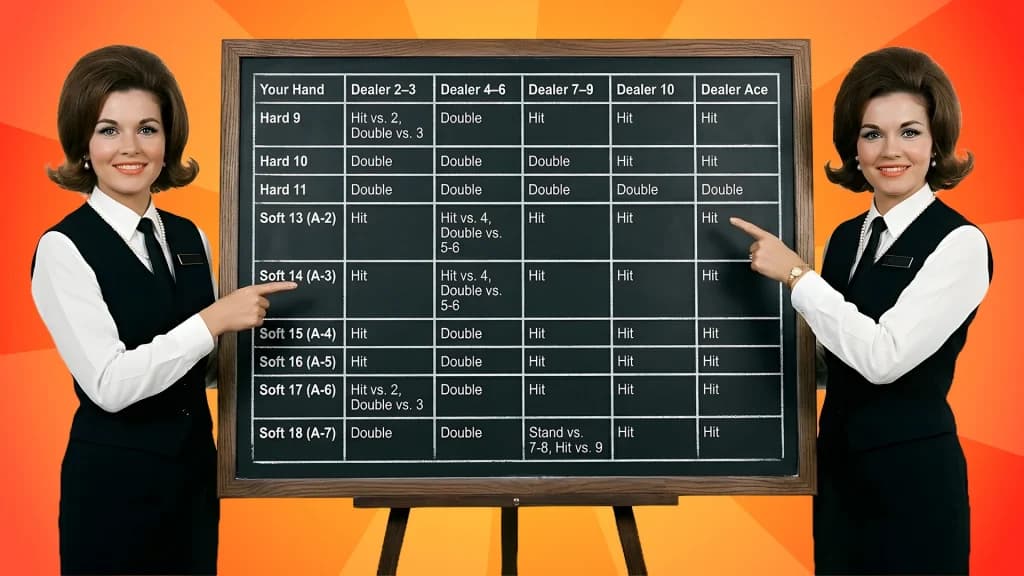
The table below shows you when to double down. It follows standard multi-deck basic strategy, assuming the table allows doubling on any first two cards.
| Your Hand | Dealer 2–3 | Dealer 4–6 | Dealer 7–9 | Dealer 10 | Dealer Ace |
| Hard 9 | Hit vs. 2, Double vs. 3 | Double | Hit | Hit | Hit |
| Hard 10 | Double | Double | Double | Hit | Hit |
| Hard 11 | Double | Double | Double | Double | Double |
| Soft 13 (A-2) | Hit | Hit vs. 4, Double vs. 5-6 | Hit | Hit | Hit |
| Soft 14 (A-3) | Hit | Hit vs. 4, Double vs. 5-6 | Hit | Hit | Hit |
| Soft 15 (A-4) | Hit | Double | Hit | Hit | Hit |
| Soft 16 (A-5) | Hit | Double | Hit | Hit | Hit |
| Soft 17 (A-6) | Hit vs. 2, Double vs. 3 | Double | Hit | Hit | Hit |
| Soft 18 (A-7) | Double | Double | Stand vs. 7-8, Hit vs. 9 | Hit | Hit |
If you remember nothing else from this guide—first of all, ouch, but second, remember to double down on a hard 11.
Virtually any card at that point can improve you to a powerful total. Draw a 10-value card, and you make 21. Draw a 9, and you have 20. Even an 8 gives you 19. You’re also not at risk of busting, because even if you pull an Ace, your new total would be 12, not 22.
No risk of busting and a high chance of reaching 21? Sounds like a killer deal. We’ll take two, please.
Now, some notes on the dealer’s upcard.
Pay Attention to the Dealer’s Upcard
When the dealer is showing 4, 5, or 6, they’re in a very awkward position because they’re more likely to bust while trying to reach 17. That’s why you see so many doubles against those upcards. Kick ‘em while they’re down, essentially. Not how Bob Ross would’ve handled it, but acceptable behavior for a blackjack player.
You might also notice that hard and soft hands have different moves against the same dealer card. That’s because soft hands have the added flexibility of the shape-shifting Ace, which can count as either 1 or 11, depending on convenience. If only calories worked that way. Because of this flexibility, you literally can’t bust, opening the door to play more aggressively.
A hard total, on the other hand, is unchanging. You’re at a higher risk of busting without the 1/11 safety net, so you only double when your odds of improving outweigh the risk of going over 21.
Consult a Complete Strategy Chart
If your hand doesn’t appear in the table, basic strategy doesn’t recommend doubling it. Those hands are better played by hitting, standing, or splitting instead.
If you’d rather memorize the patterns than check a chart every session, our guide on how to memorize blackjack basic strategy can help you recognize the moment and make quick, snap decisions.
When Not to Double Down
Knowing when not to double down is just as valuable as knowing when to go for it. If you double down when you shouldn’t (like telling her that dress really does make her look a bit heavier than usual), you could end up paying far more than you wanted. Oh, heavens, ain’t that the truth?
Avoid Doubling On Hard Totals of 12 or Higher
The first hands to avoid are hard totals of 12 or higher. Once you commit to a double, you’re only getting one more card. With so many 10-value cards in the deck, there’s simply too much risk of busting without the opportunity to recover.
Be Wary of Dealer’s 10 and Ace
You should also think twice whenever the dealer shows a 10 or an Ace. Those are the dealer’s strongest starting cards, making it much more likely they’ll finish with a winning total. Even a decent hand of your own usually isn’t enough reason to risk another full bet.
Leave Good Hands Alone
Finally, don’t try to improve hands that are already doing just fine. A hard 19 or 20 doesn’t need fixing. Drawing one mandatory card is far more likely to weaken the hand than to improve it.
Avoid Common Mistakes
Many players make one of two mistakes.
Some double too often because a hand feels strong. Others avoid correct doubles because increasing your bet feels risky. But basic strategy has already been determined. It sits comfortably between those extremes. You should double only when the math supports it, and your instincts should take a back seat.
Tip: Choose a base bet that makes doubling feel comfortable in the first place. If matching your original wager feels like a financial stretch, your opening bet is probably too large.
Doubling down means putting twice as much money on the outcome of a single card, so only make the extra wager if you’re comfortable losing it. If gambling is no longer feeling like entertainment, help is available through the National Problem Gambling Helpline at 1-800-522-4700 or ncpgambling.org.
Doubling After a Split (DAS)
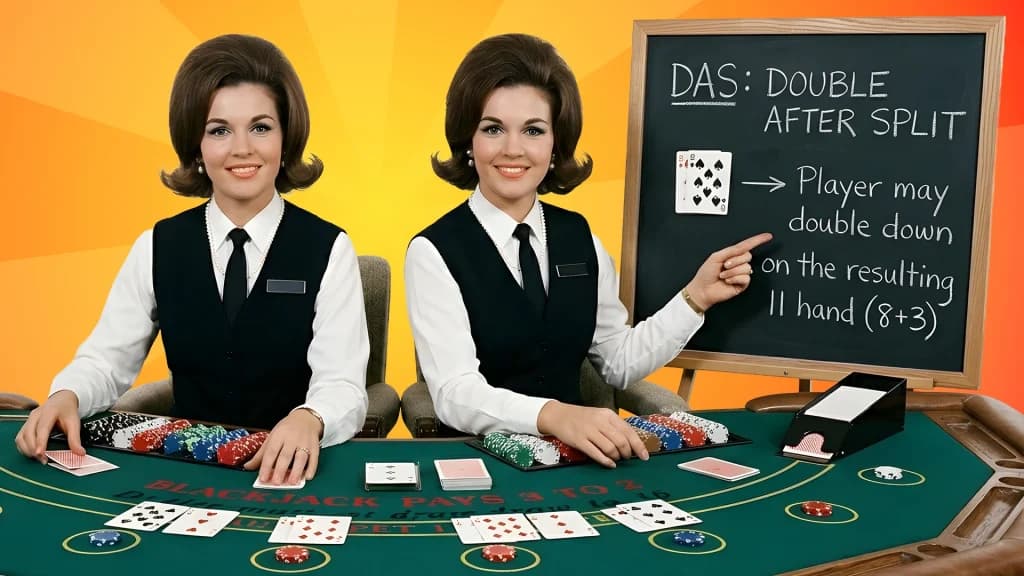
“DAS” stands for ‘double after split,’ and to be clear, it’s a table rule, not a player decision.
If DAS is allowed, then after splitting a pair into two separate hands, you can then double down on either of those two hands. Some blackjack games allow it and some don’t.
Here’s what it looks like.
Let’s say you split a pair of 8s. One of your new hands receives a 3, giving you a hard 11. Under normal basic strategy, that’s one of the best doubling hands in blackjack. If the table allows DAS, you can double that hand and receive one final card. If it doesn’t, you’ll have to play the 11 without the extra wager.
As you can imagine, the possibility of doubling after splitting can dramatically change your potential returns. It gives you another chance to increase your payout. Knowing when to split in blackjack depends on this DAS rule, since it makes some pairs more profitable to split than others.
To see if a blackjack table allows doubling after splitting (DAS), check the info panel in online blackjack or the rule card at a live table.
How Table Rules Change the Right Call
The best doubling decision in the world won’t help if the table doesn’t allow it in the first place. Before your first hand, take a few seconds to check the rules.
Some blackjack tables only allow doubling on hard totals of 9, 10, or 11. If that’s the case, you’re out of luck when it comes to soft doubles, even if the chart recommends the move.
Another rule to watch is whether the dealer hits or stands on soft 17. It might be listed as H17 or S17, respectively. H17 vs. S17 in blackjack is a big deal, because the dealer’s drawing rules affect their chances of improving. This changes your optimal move in a few doubling decisions as well.
The number of decks is another factor to consider. A single- or double-deck game has a slightly different card composition than a six- or eight-deck shoe. This pushes certain borderline doubles over the threshold in one direction or the other.
For example, when you play double-deck blackjack, you would simply hit with an 8 vs. a dealer’s 5 and 6, but in single deck, you would double down.
Fortunately, there aren’t a million rules to memorize; just a few. It’s not the Dungeons & Dragons Player’s Handbook; that’s for sure.
Check the ruleset before you play, then use the version of the doubling chart that matches the game in front of you. Once you’ve done that, it’s smooth sailing until you reach the loot.
What Doubling Down Does to the House Edge
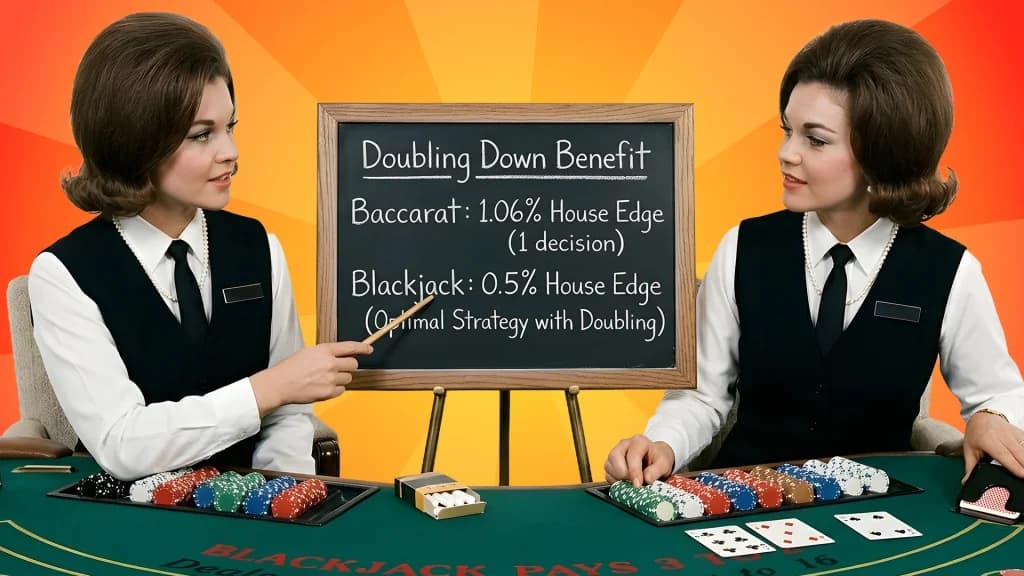
Doubling down is a huge benefit for the player, and it’s one of the reasons blackjack has a lower house edge than almost all other casino games.
Take the baccarat vs. blackjack house edge, for example. Baccarat only involves one decision, and the house edge is 1.06% at its lowest, compared to blackjack’s 0.5% with optimal strategy.
With blackjack, you have a golden opportunity to bet more when the odds briefly swing in your favor. You just have to know when to pounce.
And that’s exactly the point. You don’t just double down because you’re feeling confident. Save those moves for the extra hair gel.
You’re doubling because basic strategy has pointed out that your hand is likely to win. By investing extra money in this opportunity, you lower the casino’s long-term edge. If you skip those doubles, you give some of the advantage back.
The effect isn’t dramatic on any single hand. Truthfully, you probably won’t even notice one or two double down mistakes. The casino won’t explode, and the sun won’t disintegrate. However, if you consistently make correct doubling decisions over thousands of rounds, your wallet will feel the effects of one of the most rock-bottom house edges in casino table games.
Additionally, our poker face might disintegrate if you flash us some of those confident finger guns.
Doubling Down With Confidence
Doubling down pays off when the situation is right. Look for hard 9, 10, and 11, plus the soft hands your strategy chart recommends, especially against a dealer showing a weak upcard. Leave hard 12 or higher, dealer 10s and Aces, and already-strong totals like 19 or 20 alone.
Before you put out the extra chips, check the table rules. Restrictions on doubling, the dealer standing or hitting on soft 17, and the number of decks can all change a handful of decisions.
Once you’ve matched the right chart to the right game, all that’s left to do is to trust the math. Easy, right?
It’s double, double, toil and trouble. Fire up your device and play blackjack games online. It’s time to put those doubles to work.
FAQs
What does double down mean in blackjack?
Doubling down in blackjack means you double your original bet, take exactly one card, and stand.
When should you double down in blackjack?
You should double down when you have the strongest hard totals, such as 9, 10, or 11, against a weak dealer upcard. The exact moves, including those for soft hands, vary, so check a blackjack chart to get the full picture.
Can you double down after splitting?
That depends on whether the table offers DAS (double after splitting). It will tell you inside the info screen online or on the rules chart if you’re playing at a live casino.
Should you ever double down on 12 or higher?
Almost never because you are more likely to bust with these totals. However, there are some exceptions for soft 17 and soft 18 when playing with multiple decks.
Should you double down against a dealer ace?
No, unless you have a hard 11. An Ace is the strongest upcard for the dealer, and you are likely to lose your bet.
Can you double down after taking a hit?
No. At standard blackjack tables, you can only opt to double down after your two cards are dealt and before you make any other move.
Does doubling down lower the house edge?
Yes. When you double down at the correct times, it does reduce the house edge by fractions of a percentage. The opposite is also true. When you double down when it’s not mathematically recommended, the house edge increases.
More Blackjack Tips

August 4, 2026
Blackjack Bankroll Management: How to Set Limits, Size Your Bets, and Play Longer
Blackjack Bankroll Management: How to Set Limits, Size Your Bets, and Play Longer Pull up a chair. You’ve picked your table, you know your cards, and you’ve got one more thing to sort out before the first hand: a plan for your money. That’s blackjack bankroll management in a nutshell, not a high-roller system, not […]

August 4, 2026
How to Memorize Blackjack Basic Strategy
Wondering how you can remember all the different plays for blackjack hands? We have some handy charts to help you memorize blackjack strategy down pat
March 12, 2026
What is a Soft 17 in Blackjack? The Make or Break Hand
A soft 17 in blackjack isn’t your average soft hand. The rules behind it directly affect your house edge. Learn how it works & how to deal with it.
July 21, 2025
Ace Up Your Sleeve: How to Play a Blackjack Soft 16
With a soft 16 in blackjack, the trick is considering the dealer’s upcard before making your move. Learn how to handle a soft 16 for your best winning chance.