Blackjack Card Values Explained
Good news: the card values in blackjack are the easiest thing about the game. You can learn the whole system in about two minutes, and once you have them down, you have the foundation for everything else. No math background needed, no table experience required. Just three simple rules and you’re ready to total a hand.
By the end of this guide you’ll know: how number cards are counted, why the Jack, Queen, and King are all worth the same, and what makes the Ace the most interesting card on the table.
Understanding Card Values in Blackjack
Here’s the complete picture in one sentence: number cards are worth their printed number, face cards (Jack, Queen, King) are each worth 10, and the Ace is worth either 1 or 11, whichever helps the hand more.
| Card | Blackjack Value |
| Number cards (2–9) | Face value, a 7 is worth 7, a 3 is worth 3 |
| 10, Jack, Queen, King | 10 |
| Ace | 1 or 11 (whichever benefits the hand) |
A few things worth noting from the start. Suit, hearts, spades, clubs, diamonds, has no effect on card value. A queen of hearts and a queen of clubs are both worth 10. These values also stay consistent across blackjack variations. The payouts, the number of decks, and the dealer’s rules on soft 17 can all vary by game, but a nine is always worth nine.
Face Card Values
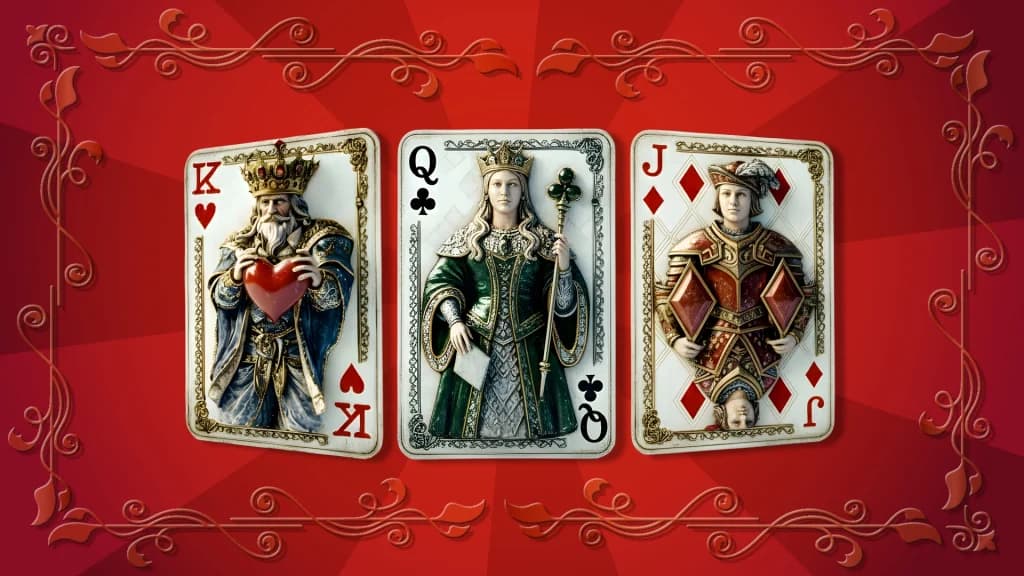
The Jack, Queen, and King are each worth exactly 10. Full stop. No face card outranks another in terms of value, a King isn’t worth more than a Jack, and a Queen isn’t more powerful than either. They’re all interchangeable at 10 points.
This matters more than it might seem at first glance. Add the 10 card itself, and you’ve got four card types all worth the same value. That’s 16 cards per deck that count as 10, roughly 30% of a standard deck. Which is why getting a 10-value card on any given hand isn’t exactly a long shot.
Value of Aces
An Ace is worth 1 or 11, and the hand picks whichever value is better at any given moment. That’s it. The Ace isn’t locked in at one number, it’s flexible, and the game handles that flexibility automatically.
Say you’re dealt an Ace and a 6. The Ace counts as 11, giving you a total of 17, a solid hand to stand on. But then you draw a 9. If the Ace stayed at 11, you’d bust at 26. Instead, it drops to 1, and your total becomes 16. The Ace saved the hand simply by changing its value to fit the situation.
That flexibility is exactly what makes the Ace the most valuable card in the deck. You can’t bust on a two-card hand that contains an Ace, the worst you can do is have a flexible total that needs work. The strategic implications come later; the value rule itself is straightforward.
Working Out Your Total Hand Value
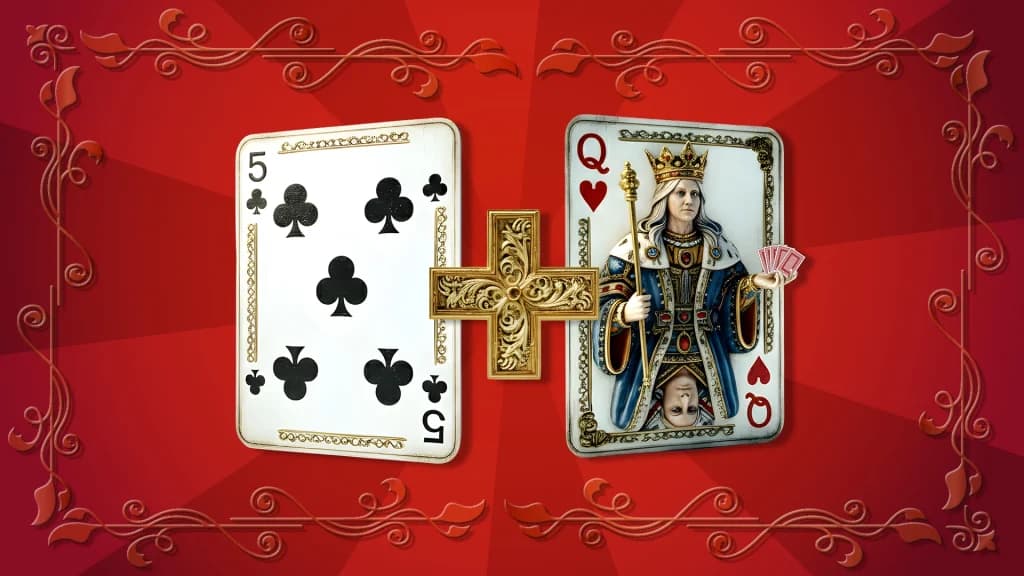
A hand total is the sum of the values of all cards in the hand. Add them up. That’s the whole calculation.
Example 1, Two number cards: A 7 and a 4. Total: 11. Easy.
Example 2, A face card in the mix: A King (10) and a 5. Total: 15.
Example 3, A hand with an Ace: An Ace and a 6. The Ace is 11, total is 17. Draw a 9, Ace drops to 1, total becomes 16.
The natural (blackjack): An Ace paired with any 10-value card on the opening deal is called a natural, or a blackjack. The total is 21, and it typically earns a 3:2 payout, meaning a $10 bet pays $15 rather than the even $10 you’d get from a regular win. Some games pay 6:5 on a natural; always check the table rules before sitting down, because that difference matters.
Soft Hands vs. Hard Hands
A soft hand contains an Ace that’s currently counting as 11. A hard hand either has no Ace, or has an Ace that’s been forced down to 1 because counting it as 11 would bust the hand.
Soft hand example: Ace + 6 = soft 17. The Ace is acting as 11. If you draw and get a high card, the Ace can drop to 1 to protect you from busting. Soft hands give you a safety net.
Hard hand example: 10 + 7 = hard 17. No Ace in play. Every card you draw increases your risk of going over 21. Hard hands carry more bust risk, especially at higher totals, which is why the strategy charts treat soft and hard totals differently.
Understanding the difference between soft and hard hands is one of the first things worth internalizing, because it changes which plays make sense at any given moment.
Now You Know Your Blackjack Card Values
Three rules: number cards at face value, face cards at 10, and the Ace at 1 or 11. With those in place, you can total any hand you’re dealt without hesitation.
The next step is putting that knowledge to work. Head over to how to practice blackjack to get comfortable before the real thing, and then come find your table at Cafe Casino blackjack.
Set a budget that works for you and play within it. For support, the National Problem Gambling Helpline is available at 1-800-522-4700 and ncpgambling.org.
FAQs
How much is a King worth in blackjack?
A King is worth 10. So is the Queen, the Jack, and the 10 card itself. All four card types share the same value, none outranks another.
How much is a Jack worth in blackjack?
10, same as the Queen, King, and 10 card. Face cards and tens are interchangeable for the purposes of hand totaling.
How much is an Ace worth in blackjack?
An Ace is worth 1 or 11, whichever benefits the hand. If counting it as 11 would take you over 21, it automatically becomes 1.
Does a card’s suit change its value in blackjack?
No. Suit plays no role in blackjack card values. Only the rank of the card determines what it’s worth, a Jack of spades and a Jack of hearts are both worth 10.
Do blackjack card values change in different variations?
The values stay the same across all standard variations, a 7 is always 7, a King is always 10, and an Ace is always 1 or 11. What changes between variations is things like payout rates, deck counts, and dealer rules on soft 17.
What’s the difference between a soft hand and a hard hand?
A soft hand contains an Ace counting as 11, which gives it flexibility, drawing a high card can simply flip the Ace to 1 to avoid a bust. A hard hand has no flexible Ace, so every draw increases the risk of going over 21.
What is the best possible blackjack hand?
An Ace plus any 10-value card on the opening deal, that’s a natural 21, or blackjack. It typically pays 3:2 on your bet, which is why it’s the hand every player is hoping for.
More Blackjack Tips
July 30, 2026
What Is Insurance in Blackjack?
Blackjack insurance pays 2:1 but carries a 7.5% house edge. Learn how it works, when to take it, and why basic strategy says skip it.

April 10, 2026
Is blackjack rigged? (No, and we’ll show you why)
We’ve all asked ourselves at least once: Is blackjack rigged? Learn why it feels that way, why it is not rigged, and what’s really going on behind the scenes.
April 10, 2026
Blackjack Side Bet Sampler: Each One Explained
From 21+3 to EZ Bust, get the lowdown on all of the blackjack side bets, including which ones are worth your time. Pssst: One has a payout of 1000:1.

March 23, 2026
What is even money in blackjack? A Bet You Should Skip
Is even money in blackjack a steal or a downgrade? Learn what to do when you have a natural and the dealer shows an ace. Spoiler: don’t take it. This is why.