Blackjack Payout Chart: What Every Hand and Bet Pays
You’re holding your first two cards, and the tension is real as you wait for the dealer’s upcard. They bust, which could only mean one thing: it’s payday time. The next question is: how much did you win?
The payout is 1:1 for a regular win in blackjack and 3:2 for a natural, though some tables reduce the natural blackjack payout to 6:5.
In this guide, we’ll clear up how payouts in blackjack work, taking you through the standard payouts and returns for different bet sizes, the dollar difference between 3:2 and 6:5 blackjack payouts, plus payouts for insurance, surrender, and the most common side bets.
It pays to pay attention, but as long as you keep this page within arm’s reach, there will be no mental math required.
Table of Contents
- Blackjack payouts at a glance
- How to read blackjack payouts
- 3:2 blackjack payout chart by bet size
- 6:5 blackjack payout chart
- 2:1 vs 3:2 payout
- Insurance, even money and surrender payouts
- Blackjack side bets payouts
- Blackjack payout cheat sheet
- FAQs
The Blackjack Payout Chart at a Glance
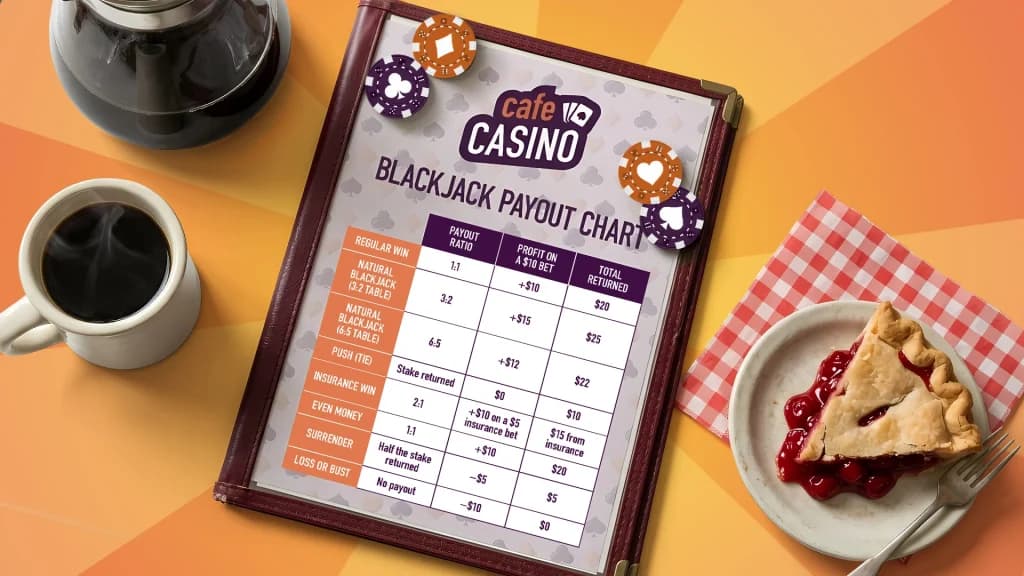
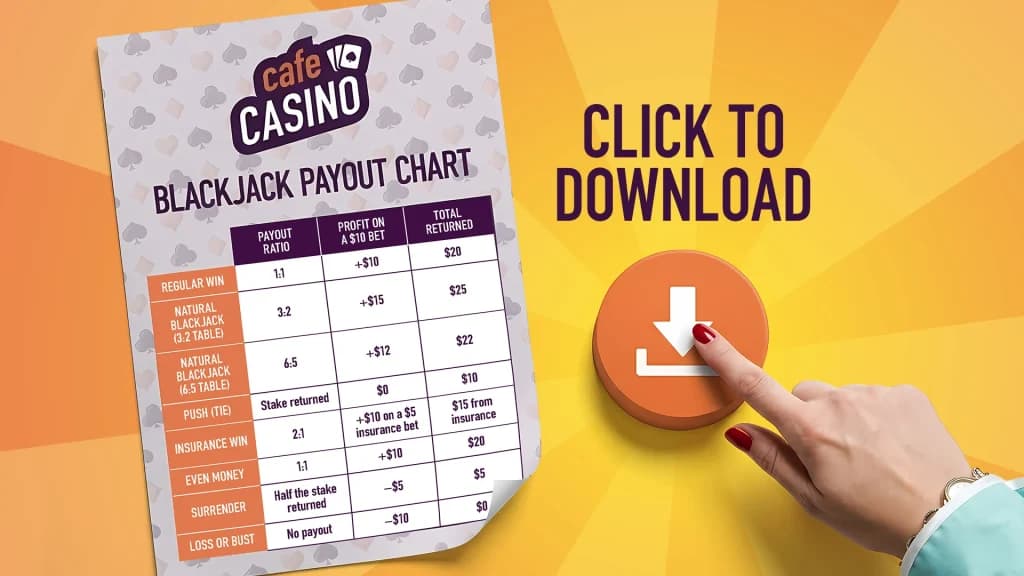
The chart below gives your profit and total return for every standard outcome in blackjack.
| Payout Ratio | Profit on a $10 bet | Total Returned | |
| Regular win | 1:1 | +$10 | $20 |
| Natural blackjack (3:2 table) | 3:2 | +$15 | $25 |
| Natural blackjack (6:5 table) | 6:5 | +$12 | $22 |
| Push (tie) | Stake returned | $0 | $10 |
| Insurance win | 2:1 | +$10 on a $5 insurance bet | $25 from insurance |
| Even money | 1:1 | +$10 | $20 |
| Surrender | Half the stake returned | −$5 | $5 |
| Loss or bust | No payout | −$10 | $0 |
When you win in blackjack, the game gives you your original bet back and your profit on top of it. That’s why a regular $10 win is actually a $20 return.
If you and the dealer end up with the same total, that’s a push (a tie), and you get your bet back without a profit.
A natural blackjack refers to an ace and a 10-value card in your first two cards. If you split and receive a blackjack or you hit and reach 21, you receive the standard 1:1 payout, not a blackjack payout.
How to Read Blackjack Payouts
In a payout ratio, such as 1:1 or 3:2, the first number is what you win, and the second number is what you bet.
For a 1:1 payout, you win $1 per $1 you bet. In a 3:2 payout, you win $3 for every $2 you bet. In both cases, you receive your original stake back on top of your profit.
Let’s go through it with a real bet.
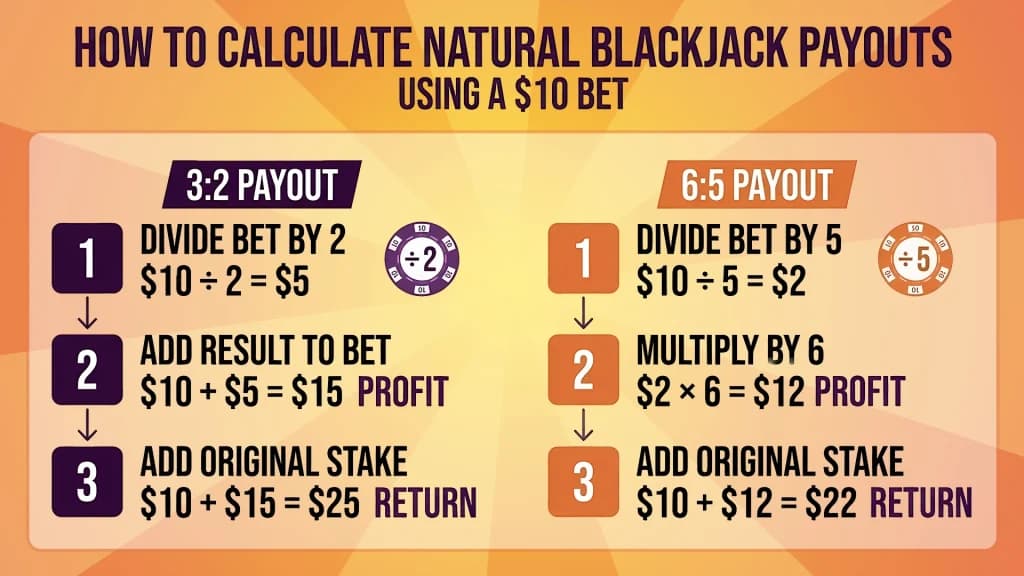
How to calculate a 3:2 payout on a $10 bet
- Divide your bet by two. $10 ÷ 2 = $5
- Add the result to the original bet. $10 + $5 = $15. That’s your profit.
- Add your $10 stake to your $15 profit. $10 + $15 = $25. That’s your return.
How to calculate a 6:5 payout on a $10 bet
- Divide your bet by five. $10 ÷ 5 = $2
- Multiply the result by six. $2 X 6 = $12. That’s your profit.
- Add your $10 stake back to your $12 profit. $10 + $12 = $22. That’s your return.
To qualify for a blackjack payout, your first two cards must be an Ace + a 10-value card, which, in the language of blackjack card values, includes the regular 10, Jack, Queen, or King. If you have a lower total and hit to reach 21, or if you split aces and receive a 10-value card, you receive a standard 1:1 payout. You may now bow your head and pay your respects to the fallen 3:2. At least someone’s getting paid.
Quick tip: Online blackjack will pay you to the cent exactly. If you bet $15 and win a 3:2 payout for a blackjack, you’ll receive exactly $22.50 in profit. A land casino might reduce the payout to $22 because of the awkward chip size.
3-to-2 Blackjack Payout Chart by Bet Size
Before playing blackjack at a land casino or online, look for “Blackjack pays 3-to-2” on the felt or in the info panel.
The table below takes you through standard blackjack bet sizes, sized from Subway Footlong to A5 Wagyu for two, and lists their total profits and returns at a 3:2 table.
| Profit at 3:2 | Total returned | |
| $5 bet | $7.50 | $12.50 |
| $10 bet | $15.00 | $25.00 |
| $15 bet | $22.50 | $37.50 |
| $25 bet | $37.50 | $62.50 |
| $50 bet | $75.00 | $125.00 |
| $100 bet | $150.00 | $250.00 |
| $250 bet | $375.00 | $625.00 |
| $500 bet | $750.00 | $1,250.00 |
Where do those extra 50 cents come from, such as “$22.50”? That’s how a 3:2 payout works with a non-whole number.
Take the $15 bet. For a 3:2 payout, divide $15 by two, and you get $7.50. Add that to $15 for $22.50 in profit. The same logic applies to the $25 bet. It pays to know!
6-to-5 Blackjack Payout Chart: What the Lower Payout Costs You
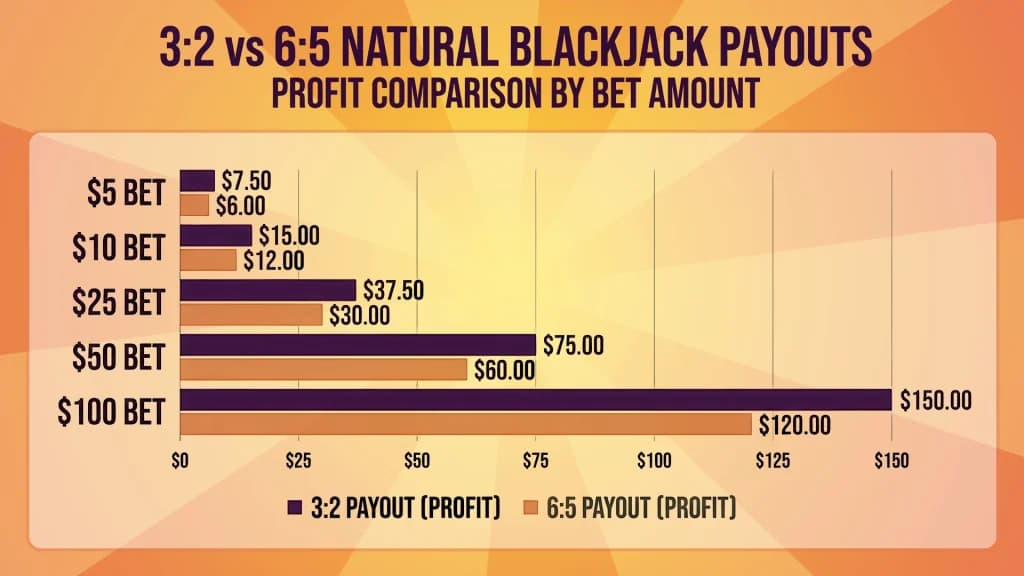
A 6:5 table looks just like a 3:2 table; you’d be none the wiser. You take a seat and play for a while with 1:1 payouts—all normal here. Then you win a blackjack. But when you count your money, you only have $12 instead of $15. Only then do you look at the rules and realize you’ve been bamboozled.
That’s why it’s essential that you start every game by verifying the blackjack payout. If 6:5 is the only table available, at least you go into it knowing what to expect. We’ll say it again: It pays to pay attention here, and we really do mean that.
The table below drives the point home with a side-by-side comparison between a 3:2 and 6:5 blackjack payout for common stakes.
| Profit at 3:2 | Profit at 6:5 | You lose per blackjack | |
| $5 bet | $7.50 | $6.00 | –$1.50 |
| $10 bet | $15.00 | $12.00 | –$3.00 |
| $25 bet | $37.50 | $30.00 | -$7.50 |
| $50 bet | $75.00 | $60.00 | -$15.00 |
| $100 bet | $150.00 | $120.00 | –$30.00 |
With all other rules equal, including whether it’s an H17 or S17 table, switching from 3:2 to 6:5 adds about 1.4% to the house edge.
If money speaks louder than words, say you hit 20 natural blackjacks on $25 bets. You’d earn $750 in profit at 3:2 and $600 at 6:5. That’s $150 less for the same 20 wins. The difference is clear: always choose a 3:2 table over 6:5.
For a closer look at the trade-off, see our guide to 6-to-5 blackjack.
Blackjack 2-to-1 vs 3-to-2: When Blackjack Pays More
There’s one payout situation we haven’t covered yet, and that’s 2:1 for a blackjack. Though rare, they do exist. If you ever catch one in the wild, it’s almost certainly tied to a promotion or a rule in a special blackjack variant.
With a 2:1 payout, winning a natural blackjack on a $10 bet would earn you a $20 profit (a $30 total return). At 3:2, you’d earn a $15 profit ($25 return).
If you see 2:1 in the game rules, it’s most likely referring to the insurance payout, which is a common and separate side bet.
If you’re unsure whether the 2:1 payout is for a blackjack, look for the crystal-clear words: Blackjack pays 2 to 1. A payout like that is something they would happily advertise.
Insurance, Even Money and Surrender Payouts
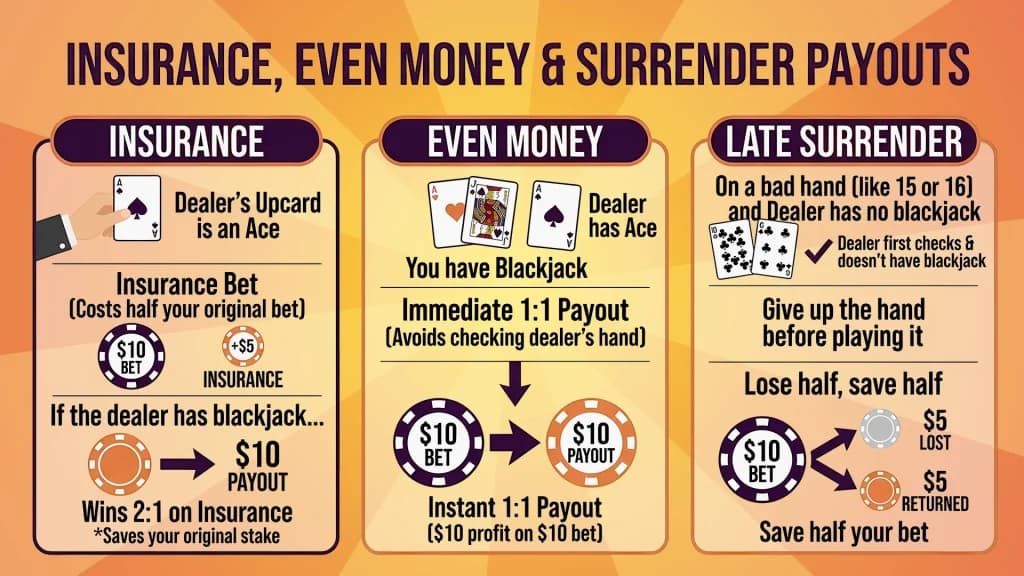
If the dealer’s upcard is an ace, the game will offer you blackjack insurance. To take it, you must pay half your original stake. If the dealer has blackjack, you win 2:1 on your insurance bet.
Even money in blackjack is similar. If you have a blackjack and the dealer has an ace, the game will offer you an immediate 1:1 payout.
Both insurance and even money will result in the same payout. Say you bet $10 and land a natural at a 3:2 table, and the dealer shows an ace.
- Even money: You immediately get a 1:1 payout of $10, whether the dealer has blackjack or not.
- Insurance: You pay $5. If the dealer has blackjack, you get paid 2:1, which is $10.
Both insurance and even money are high-house-edge side bets that optimal strategy says to avoid. If anyone tells you otherwise, we’ll be paying them a visit.
Late surrender is when you give up your hand and get half your bet back. It’s called “late” surrender because the dealer checks for blackjack first. If they don’t have it, you can surrender on a crappy hand (like 15 or 16) before you play it and save half your bet. Not all tables offer late surrender, so double-check the rules first.
Blackjack Side Bets Payout Chart
Blackjack side bets are tempting with Jamba-juicy payouts, flaunting 25:1 and 100:1 like it’s nothing. However, the tradeoff is that they’re rarer than the Butterfinger smoothie to win, and they crank up the house edge of the game.
Perfect Pairs Payouts
In Perfect Pairs blackjack, your first two cards have to match in rank. A red Queen and a black Queen make a mixed pair. Two red Queens of different suits make a colored pair. Two Queens of hearts make a perfect pair. (And three Queens make a Coachella stage with Madonna, Sabrina Carpenter, and Dua Lipa. Can’t wait.)
21+3 Payouts
With the 21+3 side bet, your first two cards have to combine with the dealer’s upcard to make a three-card poker hand. If you get the 5 and 6 of clubs and the dealer shows the 7 of clubs, you’ve made a straight flush.
Side-bet payouts vary by game, so be sure to check the paytable before you commit.
| Side bet | What has to land | Typical payout | |
| Mixed pair | Perfect Pairs | Same rank, different colors and suits | 5:1 |
| Colored pair | Perfect Pairs | Same rank and color, different suits | 10:1 |
| Perfect pair | Perfect Pairs | Same rank and suit | 30:1 |
| Flush | 21+3 | Three cards of the same suit | 5:1 |
| Straight | 21+3 | Three consecutive ranks | 10:1 |
| Three of a kind | 21+3 | Three cards of the same rank | 25:1 |
| Straight flush | 21+3 | Three consecutive cards of the same suit | 40:1 |
| Suited trips | 21+3 | Three cards of the same rank and suit | 100:1 |
Other Side Bets to Know
Super 7 Blackjack has a side bet called Super 7. It pays from 3:1 to 5000:1 depending on the number and combination of 7s that appear within your hand and the dealer’s upcard.
If you opt into the side bet in Pirate 21 blackjack, you win a payout if your first two cards match the dealer’s upcard. You get paid 9:1 for a suited match or 4:1 for a non-suited match.
Side bets have enticing payouts, but they’re rare to win. Treat them as an extra thrill, not as a likely win, and use them sparingly.
Your Blackjack Payout Cheat Sheet
Let’s review.
A regular win in blackjack pays 1:1, a natural blackjack pays 3:2, and insurance pays 2:1. Avoid 6:5 tables if you can, and focus on 3:2 tables instead.
Download the chart on this page and keep it handy when you play blackjack games online. Check your payouts as you go, and pay heed to the tips in this guide. If you win a 3:2 payout, come back and grab a special booth, because we’ll be paying you a compliment.
Blackjack Payout Chart FAQs
What does blackjack pay?
A regular win pays 1:1, a natural blackjack pays 3:2 or 6:5 depending on the table, and a winning insurance bet pays 2:1. Refer to the blackjack payout chart above to see your profit and total return for each payout.
How do you calculate a 3-to-2 blackjack payout?
Divide your bet by two, then add the result to your original bet to find your profit. If you bet $20, you’d divide it by two to get $10, then add $10 to $20 for $30 in profit. You also get your $20 stake back, so you receive $50 total.
How much does a $25 blackjack pay?
If you bet $25 and won a blackjack at a 3:2 table, your profit would be $37.50 out of a $62.50 total return. At a 6:5 table, the same bet would earn you a $30 profit for a $55 total return.
Is 6-to-5 blackjack worth playing?
The fact is that a 3:2 table gives you better value, assuming all other rules are the same. On a $10 bet, 6:5 pays you $3 less every time you hit a natural blackjack.
Does 21 after a split pay 3-to-2?
In the vast majority of tables, a 21 after a split pays the regular rate of 1:1, not the blackjack rate of 3:2/6:5. Only a two-card natural in your initial two cards earns the blackjack bonus.
What does insurance pay in blackjack?
Insurance pays 2:1 if the dealer has a blackjack. When the dealer shows an ace, the game offers you the option to bet half your wager. If you bet $5 for insurance, you’d earn a $10 profit. It’s a poor-value side bet.
Which blackjack side bet pays the most?
A Suited Trips from the 21+3 side bet pays 100:1, and a Perfect Pair pays 25:1, but proceed with caution. Side bets have a significantly higher house edge than the standard blackjack bets.
More Blackjack Guides

November 3, 2026
Blackjack Guide: How to Play, What to Bet, and When to Make Your Move
Learn how to play blackjack, including the card values, the five key moves you can make, and a handful of special hands. It’s easy once you get the hang of it.
September 21, 2026
Blackjack Terms: A Guide to the Language of the Table
This blackjack glossary covers all of the terms you’ll hear when playing blackjack, from moves to rules to slang. Learn the terms now, grouped by situation.
July 15, 2026
Early Payout Blackjack: Should You Use It?
Not sure what early payout blackjack means or whether to use it? This guide explains how the feature works, how the offer is calculated, and when it makes sense.

April 10, 2026
Is blackjack rigged? (No, and we’ll show you why)
We’ve all asked ourselves at least once: Is blackjack rigged? Learn why it feels that way, why it is not rigged, and what’s really going on behind the scenes.