Blackjack Chart Explained: How to Read and Use a Basic Strategy Chart
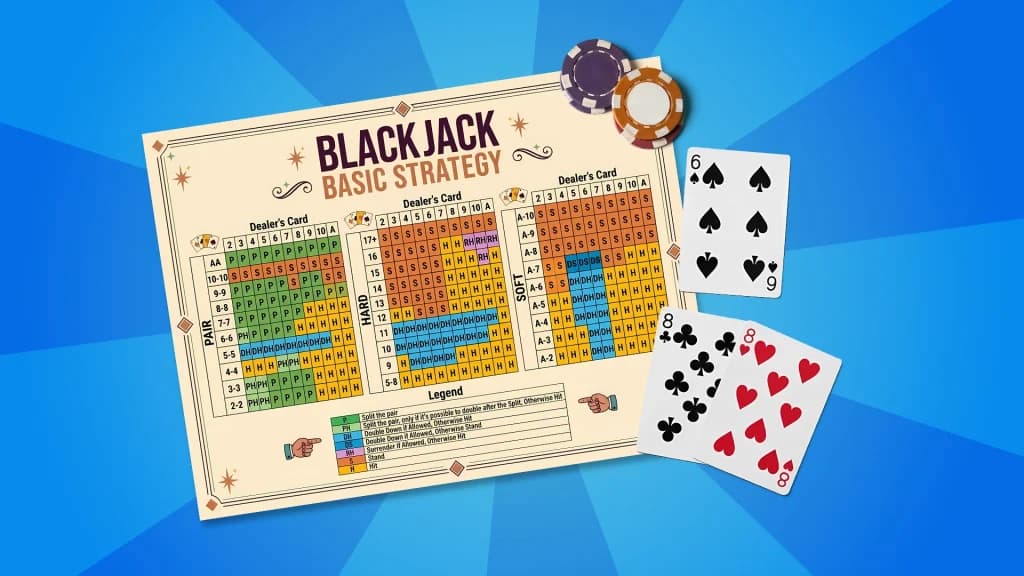
You have two 8s, and the dealer shows 6. Your instinct is to split, but then you second-guess yourself. Was it ‘always’ or ‘never’ split 8s? That’s when you whip out the blackjack chart and your brow unfurrows. Yes, you always split 8s. Your hunch was right!
That see-saw moment where you’re not sure what to do is why blackjack strategy charts exist in the first place. It’s your trusty assistant, and it’s always prepared with the most mathematically correct move for any situation.
Using a blackjack chart cuts the house edge, but it doesn’t guarantee wins.
We’ll show you how to use one, including reading, using, and adapting the chart to your particular game.
Table of Contents
- What is a blackjack chart?
- How to read a Blackjack strategy chart
- The basic Blackjack strategy chart
- Hit, stand, double or split
- Blackjack single deck rules changes
- Blackjack deviation charts
- How to practice with a chart
- Key takeaways
- FAQs
What Is a Blackjack Chart?
A blackjack chart is a grid showing the mathematically best move for every combination of your hand and the dealer’s upcard. You’ll need to be familiar with blackjack card values to use it.
It’s a tool that’s known by many names: blackjack strategy chart, basic strategy chart, blackjack cheat sheet, and blackjack betting chart, to name a handful of popular nicknames.
The mathematically correct moves are decided based on millions of simulated hands. Some come out way ahead, and others win by a hair. When you practice each decision as the chart says, you reduce the house edge to under 1%, assuming you’re playing at a table with favorable rules.
Basic strategy charts give you the optimal move based on your hand and the dealer’s upcard.
Deviation charts are for card counters. The chart identifies specific situations where you should change a basic strategy move because of the favorable count. Alan from The Hangover had clearly studied one.
How to Read a Blackjack Strategy Chart
Let’s say you have 9 + 4 (13) and the dealer shows a 7. To find your move, locate the row labeled “13” and the column labeled “7”. Track both of them until they meet at one cell. The letter in that cell is “H”, which means you should hit.
If you draw a 2, you now have a hard 18. Check again, and “S” tells you to stand, or stay.
Your Hand vs. the Dealer’s Upcard
Looking at the blackjack chart, the rows show your hand total, and the columns show the dealer’s visible card. The cell where they meet is the move you make.
The Chart Legend: H, S, Dh, Ds, P, and R
| What It Means | If Not Allowed | |
| H | Hit | – |
| S | Stand | – |
| Dh | Double down if allowed; otherwise hit | Hit |
| Ds | Double down if allowed; otherwise stand | Stand |
| P | Split | Play the hand as a hard or soft total |
| R (Rh/Rs) | Surrender (Surrender; hit if not allowed / Surrender; stand if noy allowed) | Rh: hit / Rs: Stand |
Which Section of the Chart to Check
First, see what kind of hand you have. If you have a hard 16 but it’s made of two 8s, go to the “Split” section of the chart. If you’re holding a soft hand with an Ace, look for the “Soft Hands” part of the chart. Standard hands without an Ace or doubles fall under “Hard Totals”.
The Blackjack Basic Strategy Chart
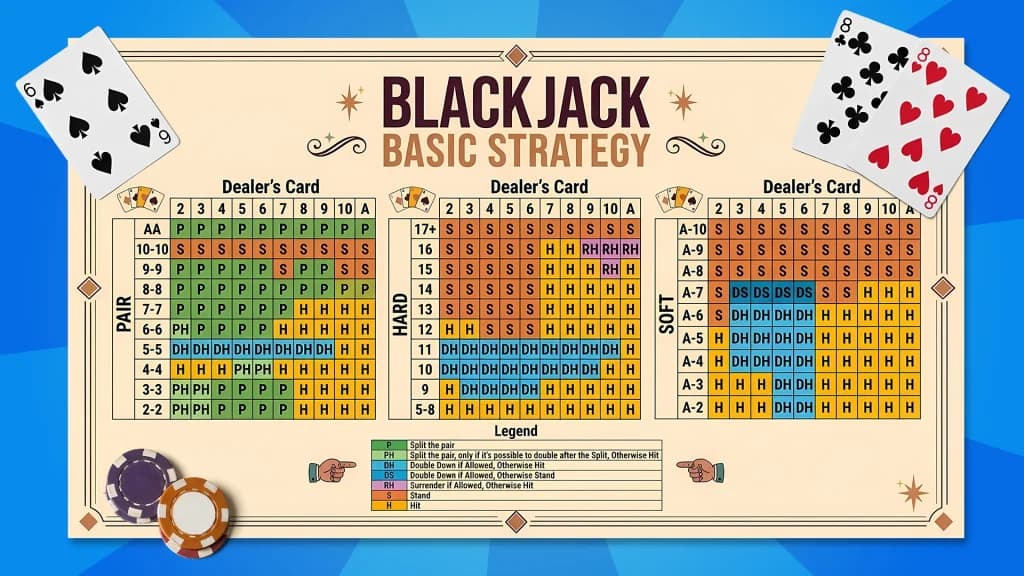
Bring on the chart!
The chart you see here is a 6-deck blackjack chart, where the dealer stands on soft 17 (S17), you can double after a split (DAS), and late surrender is offered.
A wise tip up your sleeve: A table with a different number of decks or different rules will recommend slightly different decisions, so always double-check the rules before you follow the chart.
Hard Totals Chart
Use the strategy chart for hard totals if your hand is standard (no Ace) and not doubles. Examples are: 6 + 5, 10 + Q, 4 + 2, and 3 + J.
You might be surprised to see that you’re supposed to stand on any hard total of 13 or more against a dealer 2 through 6. While some of those totals aren’t anywhere close to 21, you still stand because those upcards are particularly weak for the dealer. They must keep drawing until they reach 17, and starting with these low cards increases their chances of busting. Standing transfers the risk to the dealer.
Soft Totals Chart
A soft total is any first two cards that contain an ace. They’re “soft” because the ace can change from 11 to 1 to save you from busting.
This added flexibility means you can hit or double more often, since you can rely on your ace safety net to bail you out.
Look at a soft 18 (A + 7) and a soft 17 in blackjack (A + 6). You might initially believe that they’re good hands to stand on, since you’d do so with hard 17 and 18.
But the optimal move for both is to double down against a dealer’s 3 through 6. The dealer is more likely to bust on those cards, but you can’t bust when you draw another card thanks to the ace.
Pairs Chart (When to Split)
Pairs are two hands of the same value, such as 6 + 6 or K + K, and you refer to the Split chart.
So when do you split in blackjack?
You should always split 8s and never split 10s or 5s. You would mostly split low pairs against a dealer’s weak upcard, but splitting 2s and 3s against a dealer’s 2 and 3, as well as some key other matchups, is only recommended if you’re allowed to double after a split (DAS).
Hit, Stand, Double or Split: The Chart’s Key Moves at a Glance
If you’d rather understand the headline rules behind the chart moves, the lists below are the highlight reel of blackjack rules.
Hit
- Always hit 4 through 8
- Hit hard 12 against 2 or 3
- Hit hard 12 through 16 against 7 through Ace, unless surrender or splitting takes priority (Rh/Rs).
- Hit soft 17 or lower when you can’t double.
- Hit soft 18 in blackjack against 9, 10, or Ace.
A soft 18 in blackjack trips up many players, so refer to our guide for a clear breakdown.
Stand (stay)
- Stand on hard 17 or higher.
- Stand on hard 12 against 4 through 6
- Stand on hard 13 through 16 against 2 through 6.
- Surrender a 15 against 10 if allowed; otherwise, hit.
If a hard 15 confounds you like it does most, we have a guide on a hand of 15 in blackjack to help you out.
Double
- Double hard 11 against 2 through 10 if allowed; otherwise, hit.
- Double hard 10 against 2 through 9 if allowed; otherwise, hit.
- Double soft 15 and 16 against 4 through 6; otherwise, hit.
For more details, check out our guide on handling a soft 16 in blackjack.
Split
- Always split Aces and 8s.
- Split 9s in blackjack against 2 through 6, 8, or 9. Stand on the rest.
- Never split 5s or 10s.
Our guide explains why you should always split 8s in blackjack and when to split 9s in blackjack.
Be sure to review and avoid the most common rookie blackjack mistakes before you play, too. No reason to be an absolute noodle if you can avoid it. The only noodles we want at this table come with pork broth, a jammy egg, and a little seaweed on the side. We’ll take three ple—oops, wrong table.
Does the Blackjack Chart Change With the Table Rules?
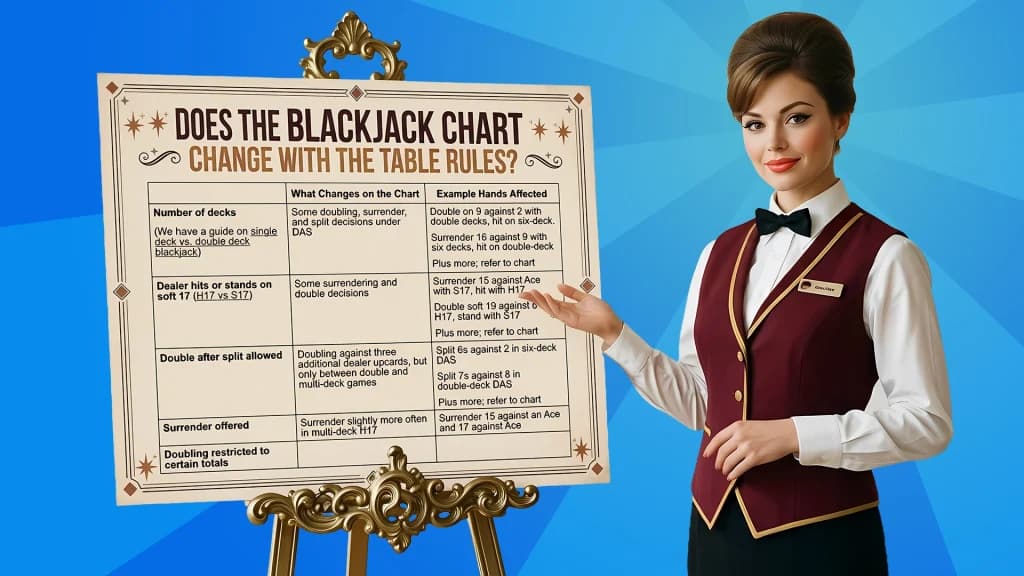
Blackjack tables don’t all follow the same rules, so there are different blackjack charts floating around with a handful of key decisions changed, including the number of decks used.
The only rule that doesn’t change the chart is a 6:5 blackjack payout, but it does increase the house edge and reduce your payout for landing a natural. Avoid that one if you can.
| What changes on the chart | Example hands affected | |
| Number of decks (Single deck vs double deck comaprison guide) | Some doubling, surrender, and split decisions under DAS | Double on 9 against 2 with double decks, hit on six-deck. Surrender 16 against 9 with six decks, hit on double-deck Plus more; refer to chart |
| Dealer hits or stands on soft 17 (H17 vs S17) | Some surrendering and double decisions | Surrender 15 against Ace with S17, hit with H17 Double soft 19 against 6 with H17, stand with S17 Plus more; refer to chart |
| Double after split allowed | Doubling against three additional dealer upcards, but only between double and multi-deck games | Split 6s against 2 in six-deck DAS Split 7s against 8 in double-deck DAS Plus more; refer to chart |
| Surrender offered | Surrender slightly more often in multi-deck H17 | Surrender 15 against an Ace and 17 against an Ace |
| Doubling restricted to certain totals | If doubling isn’t allowed, either hit or stand, depending on the hand (Dh / Ds) | 10s, 11s, and all doubles |
Beyond Basic Strategy: Blackjack Deviation Charts
A blackjack deviation chart, like the Illustrious 18 chart, is different from a basic strategy blackjack chart. Card counters use deviation charts to tell them when to deviate from basic strategy based on the “true count” of how many high cards are left in the shoe.
For example, if the true count is +3 or higher, the deviation chart says to take insurance, which would be an absolute no-no in standard blackjack strategy.
Card counting relies on tracking which cards have already been dealt to estimate what’s left in the shoe. You can only do that with a physical shoe, including a live dealer online. Software-led games reshuffle every hand, making card counting impossible.
How to Practice With a Blackjack Chart
The easiest way to practice a blackjack chart is to use it. Print a blackjack chart PDF or open it in another tab on your computer. Slowly wean yourself off of it as you get more comfortable.
To memorize blackjack basic strategy and go “Look, Mom, no hands!”, learn the correct moves in stages, starting with hard totals, then soft totals, followed by pairs.
Play blackjack games online in practice play/demo mode to practice using your chart without risking real money.
When playing for real, set a budget beforehand and only wager what you can afford to lose. The blackjack strategy chart is your tool for playing smarter; it does not guarantee wins.
Key Takeaways: Let the Chart Do the Thinking
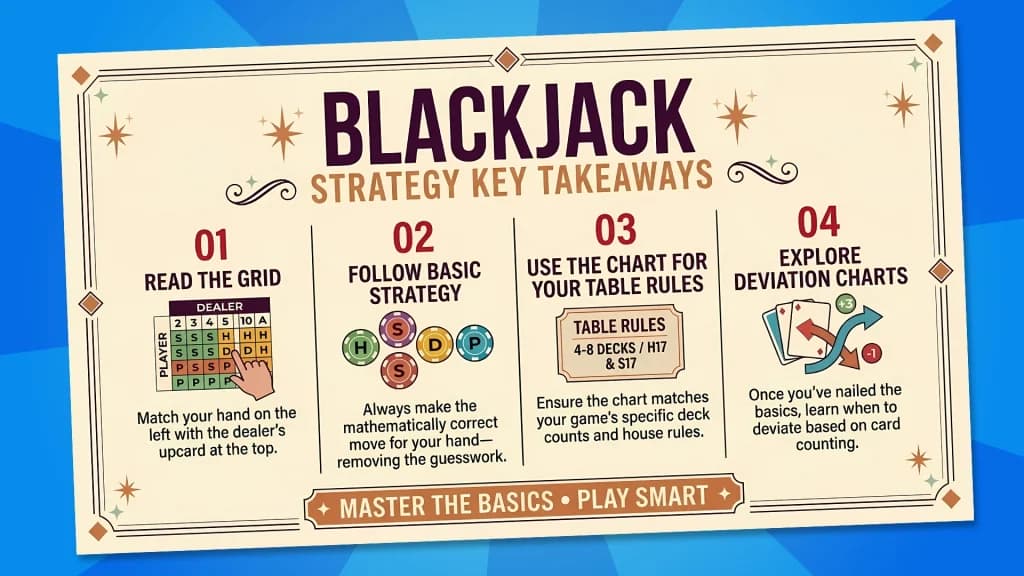
The chart is your guide. Deal yourself an edge and do what it suggests. You’ll be right up there with the rest of ‘em.
Remember to:
- Read the grid
- Follow basic strategy decisions
- Use the chart for your table rules
- Explore deviation charts once you’ve nailed the basics. Who knows? Maybe you can be Alan’s next right-hand man or woman.
You know what? We think you’re ready. Try using your shiny new blackjack cheat sheet and play live blackjack online at Cafe Casino. The dealer uses a real shoe, so go ahead and count cards if you want to—we won’t stop you. Wink wink.
FAQs
Can you use a blackjack chart while playing online?
Yes, for sure. You can always keep an online chart open while you play blackjack online. Many players print one to keep it visible at a glance.
Does following a blackjack chart guarantee you’ll win?
No. A blackjack chart is built off of the mathematically best move that improves your returns over time. It minimizes the house edge, but it does not remove it. Short-term losses are normal.
Do you hit 12 against a dealer 2?
Yes; hit hard 12 against a dealer’s 2 or 3. The dealer doesn’t bust often enough to make standing worthwhile, and it loses less on average.
Is 17 a good hand in blackjack?
Hard 17 is good enough to stand, but it doesn’t win that often. If it’s a soft 17, you should always hit to improve or even double in some circumstances.
What’s the difference between a basic strategy chart and a deviations chart?
A basic strategy chart tells you the optimal move for your hand against the dealer’s upcard. A deviations chart is for card counting. It tells you when to change certain moves based on the count.
Does card counting work in online blackjack?
Counting doesn’t help in online RNG blackjack where the cards are reshuffled after every hand. It only works in land casinos or live blackjack online where the dealer uses a shoe.
More Blackjack Guides
July 28, 2026
The 1-2-3-5 Blackjack Betting Strategy
The blackjack 1-2-3-5 betting system aims to capitalize on winning streaks and minimize losses – but does it really work? Discover tips to use it here.
October 16, 2025
What is a burn card in blackjack?
A burn card is when the dealer removes the top card of the shoe before dealing. Learn what a burn card is, why it’s useful, and if you’ll ever see it online.
January 19, 2026
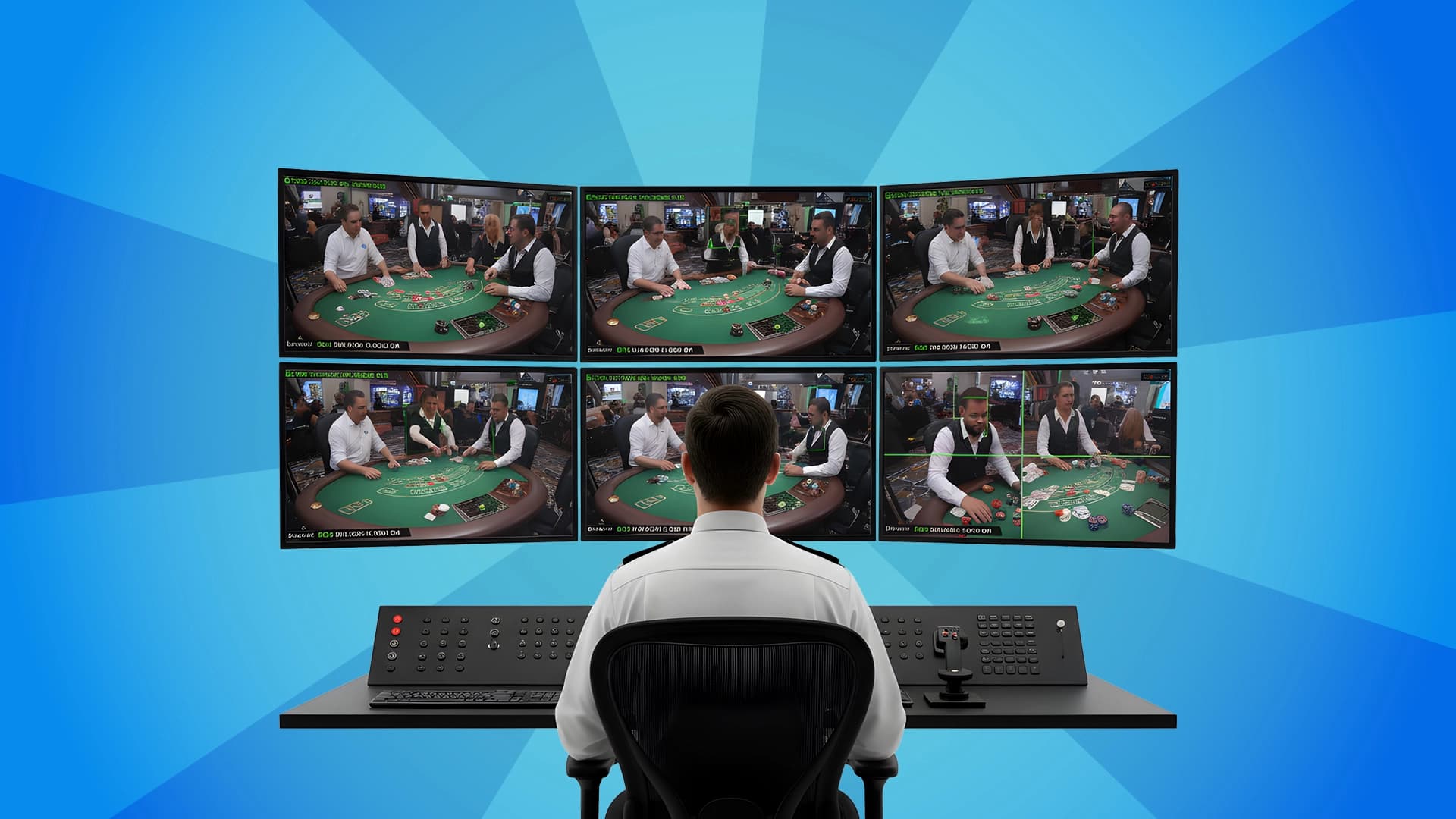
How Do Casinos Know If You’re Counting Cards?
Thinking of trying card counting? Read this first. Learn how casinos catch on, what will happen if you get caught, and what is considered real cheating.
March 12, 2026
The True Story of the Famous MIT Blackjack Team
We’ve all heard of the movie 21. But who is the real MIT blackjack team it was based on? We reveal the true story, and it’s stranger than Hollywood.