
How to Play Keno: Pick Your Spots, Watch the Draw

- What is Keno?
- How spot selection works on your Keno card
- How to play Keno
- Keno payouts
- Keno odds by spot count
- Keno FAQs
Keno is one of the easiest games you’ll find at the casino. You choose a few numbers from a grid of 80, the game draws 20 numbers at random, and then you see how many match. Done and done, and you didn’t even miss the commercial break.
If you’re playing online, the draws are instant. If you’re playing in person, they happen every few minutes, so you never have to wait long before the next round.
You can roll up to Keno, green as a spring leaf, with a few bucks, zero experience, and zero research, and win with the same odds as the old hat who’s been playing since 1972.
In this guide, you’ll learn how to play keno. You’ll discover how to fill out a keno card, how payouts work, and the odds for each spot count. Come to think of it, you’ll learn what ‘spot’ means, too!
What Is Keno?
Keno is a draw game, meaning numbers are drawn. You choose numbers from a grid of 80. The game then randomly draws 20 numbers. If those drawn numbers match your chosen numbers, you win a prize. The more matches you make, the higher your payout.
Each number you choose is called a spot. Most games let you play between 1 and 10 spots on a ticket, but at Cafe Casino, you can choose up to 15.
According to keno rules, the paytable varies with the number of spots you choose. That’s always your first decision before each draw.
Online keno at online casinos is undoubtedly popular, but you can also find it on bar screens between sips of Blue Moon, and lottery terminals between debates over lucky numbers.
The pace and presentation between keno locations might differ, but the core game remains the same: pick numbers, watch the draw, count your matches.
One last detail to remember is that every keno game has its own paytable. Two games may follow the same rules but offer different payouts, so always check the paytable before you place your bet.
The Keno Card and How Spot Selection Works
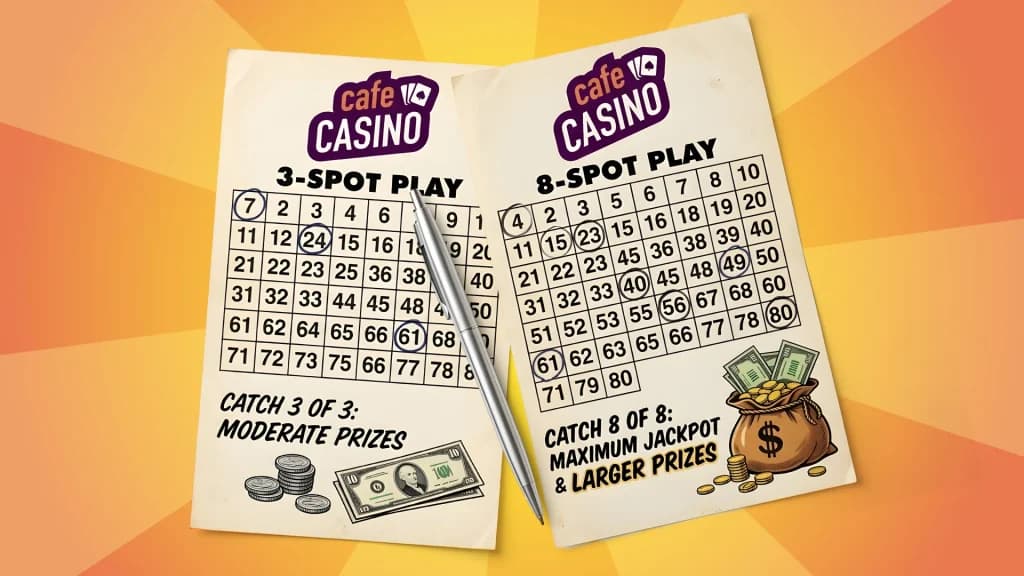
A keno card is simply a grid of numbers from 1 to 80. It’s not like a collector’s Pokémon or Magic card, but the prizes hopefully make up for the lack of holographic Charizards.
Your spot count is the first real decision you make in keno (also known as Keno Draw in some casinos), because it determines which paytable your ticket uses. A 3-spot ticket is scored differently from an 8-spot ticket, even if both players match the same number of picks.
If you’d rather skip the hassle of choosing numbers yourself, you could always let fate do the job by opting for Quick Pick/Auto Pick (only available for online keno, not in person). With Quick Pick, the game randomly chooses numbers for you. Even though the game chooses, the odds are exactly the same as if you hand-picked them yourself.
There is one trade-off to keep in mind. Fewer spots generally produce smaller prizes that land more often, while more spots chase much larger payouts that are far harder to hit. Neither option is better. It simply depends on the experience you’re looking for.
No matter which numbers you choose, every number from 1 to 80 has the same chance of being drawn. There are no lucky numbers or hot streaks, even if 17 is your Cafe Casino sign-up anniversary. Although that number will always be special to us.
How to Play Keno, Step-by-Step
- Choose how many spots to play.
Pick between 1 and 10 numbers (or up to 15 at Cafe Casino). Your spot count determines which paytable your ticket uses. - Select your numbers or use Quick Pick.
Tap your numbers on the card, or let Quick Pick choose them for you randomly and automatically. - Set your stake.
Choose how much you want to wager on the draw. The higher your stakes, the higher your potential prizes. - Choose the number of draws.
Decide whether you want to play a single draw or keep the same ticket active for multiple consecutive draws by using “Auto Play,” similar to slots. - Confirm your ticket.
Give your selections one last glance, then lock in your ticket before the draw begins.
- Watch the draw.
The game randomly selects 20 numbers from the full grid of 80. - Check your hits.
Compare your matched numbers with the paytable to see whether you’ve won and how much your ticket pays. If you’re playing online, the game automatically crosses off the numbers for you.
That’s the entire loop. Once you’ve learned it, you can play keno games online in under a minute, from picking your spots to seeing the result.
Keno Payouts by Spots Picked and Numbers Hit
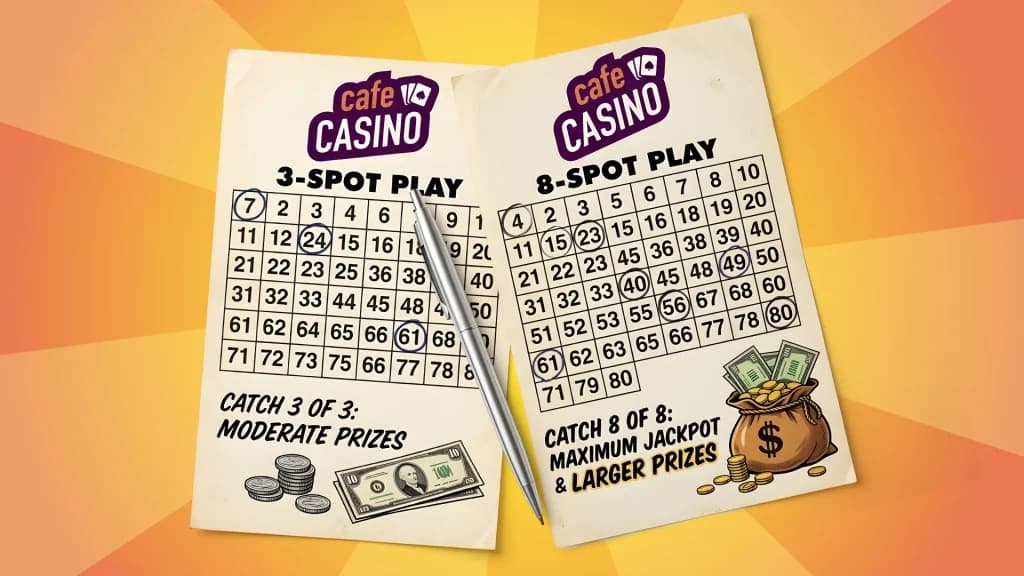
All keno payouts come down to three things:
- First, your spot count determines which paytable applies to your ticket.
- Next, the number of hits, or matching numbers, determines the prize tier you qualify for.
- Finally, your stake multiplies that payout.
The keno payout chart below shows the payouts for a $1 wager across multiple spot counts.
| Spot Count | Numbers hit that pay | Payout per $1 stake |
| 1 Spot | 1 | $3 |
| 2 Spots | 2 | $15 |
| 3 Spots | 3, 2 | $45, $2 |
| 4 Spots | 4, 3, 2 | $155, $5, $1 |
| 5 Spots | 5, 4, 3 | $850, $15, $2 |
| 6 Spots | 6, 5, 4, 3 | $2,000, $111, $6, $1 |
| 7 Spots | 7, 6, 5, 4 | $8,000, $450, $32, $2 |
| 8 Spots | 8, 7, 6, 5 | $30,000, $1,700, $135, $10 |
| 9 Spots | 9, 8, 7, 6, 5 | $50,000, $4,000, $310, $62, $6 |
| 10 Spots | 10, 9, 8, 7, 6, 5 | $100,000, $10,000, $1,200, $180, $26, $2 |
Some keno games reward you for matching zero numbers on high spot counts, which can turn a complete miss into a small payout. The Cafe Casino keno game shown above does not include those “catch nothing” prizes, so every winning ticket requires at least one paying match.
One final reminder: paytables are not universal. Keno payouts can differ between games for the same number of spots and hits. The paytable displayed inside the game is always the final authority.
Keno Odds by Spot Count
Keno follows a simple pattern, Ke-know what I mean?. Tickets with fewer spots are more likely to produce smaller wins, while tickets with more spots have the potential for much larger prizes, but they’re far less likely to land.
Neither approach is better. It simply comes down to whether you want frequent action to bump along, or a long-shot, write-to-your-friends-and-brag-for-seven-years jackpot.
This is based on a 20 spot keno card.
| Number of Spots | Odds of hitting |
| 1 Spot | 1 in 86 (1.15% probability) |
| 2 Spots | 1 in 20 (4.97% probability) |
| 3 Spots | 1 in 8 (12.48% probability) |
| 4 Spots | 1 in 4 (20.50% probability) |
| 5 Spots | 1 in 4 (23.32% probability) |
| 6 Spots | 1 in 5 (19.01% probability) |
| 7 Spots | 1 in 8 (11.32% probability) |
| 8 Spots | 1 in 20 (4.98% probability) |
| 9 Spots | 1 in 61 (1.62% probability) |
| 10 Spots | 1 in 253 (0.39% probability) |
The numbers tell a straightforward story.
A 10-spot ticket has the biggest prizes in the game, but matching every pick is a genuine long shot. It’s not impossible; Pete Davidson did date Kim Kardashian, after all, but don’t count on it as a strategy.
Most players find that the best keno strategies settle somewhere in between, depending on the style of game they enjoy, rather than trying to find a “best” spot count.
Whatever you choose, remember that keno is a game of chance. Set a budget before you play and stick to it, and only play with money you’re comfortable losing. If gambling stops being fun, help is available through the National Problem Gambling Helpline at 1-800-522-4700 or ncpgambling.org.
Ready to Pick Your Spots?

That’s the whole game, the whole Keno-kit-n-kaboodle.
Choose how many spots you want to play, pick your numbers or use Quick Pick, set your stake, and watch the draw. A minute later, you’ll know exactly how many numbers you matched and what your ticket pays.
Keno really is as simple as it looked when we started. The rules are the same on each round, so you’ll be playing with ease after just a few draws.
If you’re playing for the first time, start with a lower spot count to get a feel for the game’s rhythm. Once you know how the draws and payouts work, you can always branch out and try the bigger spot counts.
FAQs
What is keno?
Keno is a draw game where you pick numbers from 1 to 80 and hope they match the 20 numbers drawn at random. The more of your chosen numbers that match, the more you get paid.
How many numbers are drawn in keno?
Every standard keno game draws 20 numbers from a pool of 80. That’s the same whether you play online, at a bar, or through a lottery terminal.
How many numbers can you pick in keno?
Most keno games let you pick between 1 and 10 numbers (or up to 15 at Cafe Casino), known as spots. Your spot count determines which paytable your ticket is scored against.
Do I have to pick my own numbers?
No, not if you don’t want to. You could always use Quick Pick to have the game choose your numbers at random. Auto-picked numbers have exactly the same chance of winning as numbers you choose yourself.
How are keno payouts worked out?
Your payout depends on three things: how many spots you played, how many of those numbers matched, and your stake. Always check the in-game paytable, as payouts vary between keno games.
What are the odds of hitting all 10 numbers in keno?
The odds of matching all 10 numbers on a 10-spot ticket are 1 in 8,911,711. It’s a thrilling, long-shot play with the biggest prize, but it’s the least likely to win.
Is online keno the same as keno at a bar or lottery terminal?
Yes. The core game is the same: pick numbers, wait for the draw, and match as many as you can. The main differences are how quickly draws happen and the paytable used by each game. The online draw is quick and automatic, whereas the in-person draw is slower because it’s done manually.