
Count Cards Easily With the Illustrious 18 Chart (Explained)

You’re at the blackjack table, and some guy stands on 15 when the dealer shows a 10, and he wins. Either he’s a total goofnugget who just got lucky, or he’s on to something. If he had access to the Illustrious 18 chart, then it would be the latter.
You see, pro players like this aren’t psychic. They’re following a card-counting cheat sheet called the Illustrious 18. These 18 game-changing decisions tell you when to break from basic strategy depending on the count of the cards left in the shoe, and which move to make.
Let’s crack open the numbers and figure out how these “Illustrious” moves work.
Where Does The Illustrious 18 Come From?
The Illustrious 18 was the brainchild of mathematician and blackjack expert Donald Schlesinger, who first introduced it in his book Blackjack Attack: Playing the Pros’ Way.
Back in the late ’80s, Schlesinger wanted to simplify card counting for players who didn’t want to memorize hundreds of possible deviations. So, he crunched the numbers, ran the simulations, and found that just 18 specific plays accounted for nearly 80% of a card counter’s total advantage. Basically, he made the “greatest hits” album of blackjack strategy.
The Illustrious 18 became a cornerstone for anyone serious about the game. It’s a manageable way to play smarter without frying your brain with countless strategy tweaks mid-hand.
Do You Have To Card Count to Use The Illustrious 18?

Technically, yes, the Illustrious 18 is built for card counters. But before you click away thinking it’s only for math prodigies, hear us out.
Despite what Alan in The Hangover might make you believe, card counting isn’t about keeping track of every card like a human calculator, and it certainly doesn’t involve complex trigonometry, although that scene was pretty funny.
Card counting revolves around following a simple count system, like the Hi-Lo method, that helps you estimate when the deck is rich in high cards. So how would you do it? Very carefully.
How to Count Cards
Basic card counting says to assign values to the cards as they’re dealt:
- +1 for low cards (2-6)
- 0 for middle cards (7-9)
- -1 for high cards (10, face cards, and aces)
As each card hits the felt, you keep a running total in your head. When that total, or running count, climbs high, it means more high cards are left in the shoe, which is good news for you. When it drops low or negative, the deck is full of small cards.
You then convert that running count into a true count by dividing it by the number of decks left to play. That’s your “true count”, and the number you use with the Illustrious 18 chart.
When to Use the Illustrious 18
The Illustrious 18 tells you how to adjust your basic strategy depending on your true count.
Each play on the chart has an index number (+4, 0, -1, etc.), and that number acts as your trigger. When your true count meets or exceeds that index, you make the optimal move according to the chart.
For instance, you’ll see on the chart: 15 vs. 10, index +4. Our opening fellow, who we have since confirmed is not a goofnugget, chose to stand rather than the regular strategy of hitting. That means he had a true count of +4 or higher.
When the count gets high, you might also find yourself making unconventional moves, like standing on 16 vs. 8 or doubling down on 10 vs. 10. Of course, this could also be a red flag to the casino[1] that you’re counting cards, so use it wisely.
Alright, now, enough preamble. Are you ready to see the Illustrious 18 chart that turns you into Ben from 21?! Move over, Jim Sturgess, we’re comin’ in hot. Ladies and gentlemen, we present to you:
The Illustrious 18 Chart
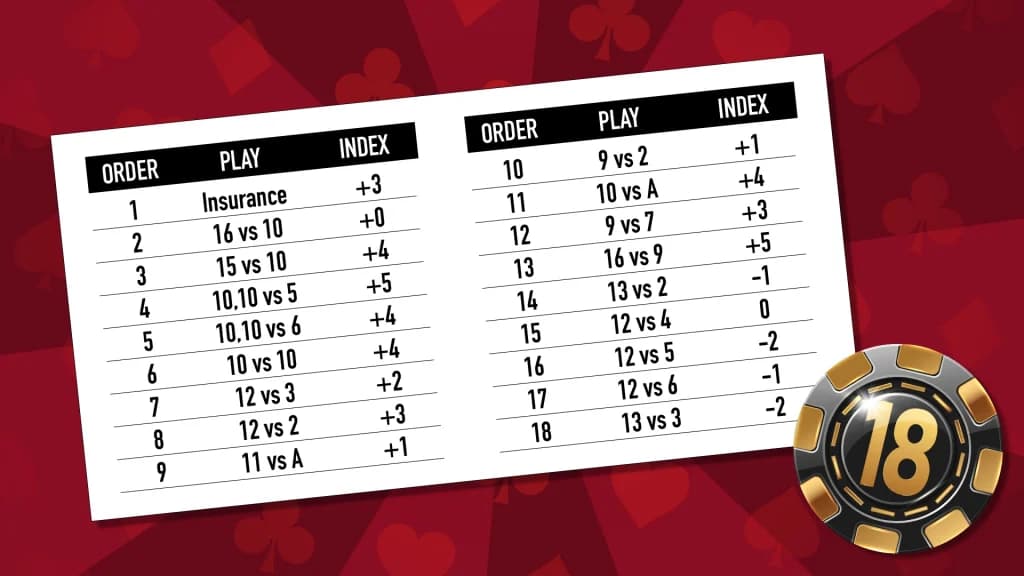
Pretty neat, right? Now, let’s help you decipher this.
Each row of the Illustrious 18 chart shows one of the 18 hands where card counters should deviate from basic strategy. The “Play” column lists your hand versus the dealer’s up card, and the “Index” column tells you the true count trigger. If your true count equals or exceeds the index, you stand, double, or split. If it’s lower, you hit. As for insurance, only take it when the true count is +3 or higher.
How to Use the Illustrious 18 Chart: an Example
First of all, bear in mind that this chart doesn’t replace basic strategy; it builds on it. You still need to start every hand by playing with basic blackjack strategy, but as you count cards using the Hi-Lo system, the count gives you extra information about what’s left in the deck.
Once you convert your running count into a true count (by dividing it by the number of decks left), you check it against the index numbers on the Illustrious 18 chart.
Here’s how it works in action.
Say you’ve got 16 vs. 10, and the chart shows an index of 0. If your true count is 0 or higher, you should stand instead of hitting. If the count is below 0, you stick to basic strategy and hit. The higher the count, the more high cards remain, which helps you when you stand and hurts the dealer when they draw.
So again, the Illustrious 18 isn’t for every hand. It’s just for those key moments when the math says the deck is lookin’ mighty fine. Counting cards tells you when those moments happen, and the Illustrious 18 tells you what to do when they occur.
What Is The Fab Four?
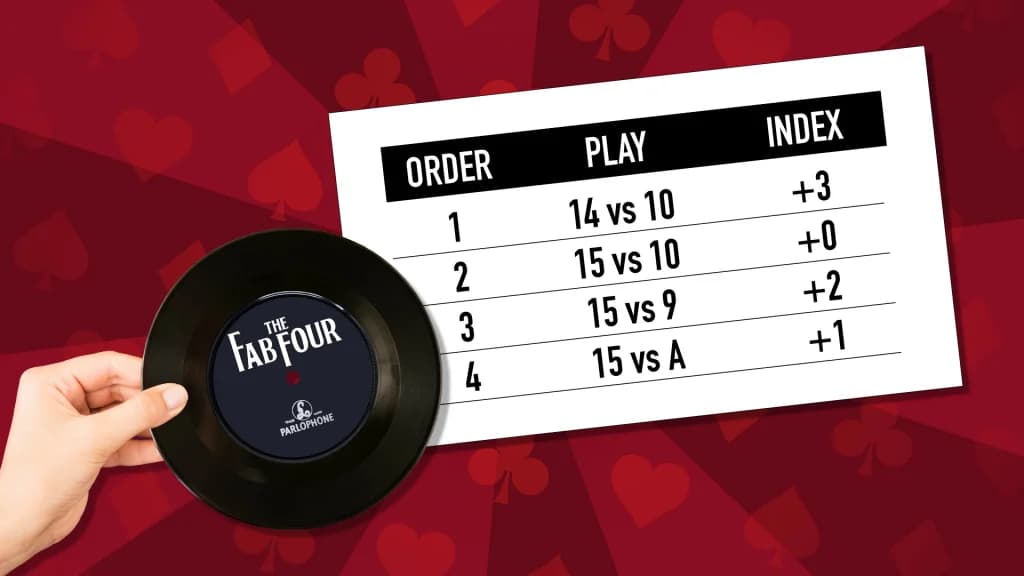
If the Illustrious 18 is blackjack’s greatest hits album, then the Fab Four is the bonus track. These are four extra plays that, when combined with the original 18, squeeze out nearly every last drop of advantage a card counter can get. They specifically deal with surrender decisions.
Donald Schlesinger introduced the Fab Four as an add-on for advanced players who already mastered the Illustrious 18. Each decision tells you when the true count is high enough to make surrendering the mathematically smarter move. For example, you might surrender 15 vs. 10 or 14 vs. 9 once the count reaches a certain threshold.
How To Calculate True Count
The true count is the secret sauce that makes card counting accurate. Your running count alone doesn’t tell the full story; it needs to be adjusted for the number of decks still in play. To get the true count, you simply divide your running count by the number of decks remaining in the shoe.
For example, say your running count is +8, but there are 4 decks left. You divide 8 by 4, giving you a true count of +2. The higher the true count, the more high cards are waiting to be dealt, and the bigger your advantage becomes.
Key Takeaways Of Using Index Play In Blackjack
Using index play, like the Illustrious 18 and Fab Four, is what separates casual players from true blackjack tacticians. Instead of taking a stab at it, you’re responding to what the math says about the cards left in the shoe. You’ll no longer sweat over what to do with a notoriously awkward 15 against a dealer’s 10. You’ll already know whether to hit or stand.
In return, you make smarter plays and shave down the house edge until it’s practically breathing down your neck. Index play doesn’t make every hand a winner, but it does mean your choices are statistically more likely to win than the average table-goer’s.
To unlock pro mode and put your skills to the test, play blackjack at Cafe Casino. You can run the Illustrious 18 as many times as you like with Practice Play, sharpening every move until your strategy’s as polished as its name implies. Then, when you’re ready to go from illustrious learner to legendary earner, switch to real money in live blackjack, with a traditional shoe, and let your gameplay shine.