
Roulette Dozens Strategy: One or Two Dozens, Please
Red and black in roulette starts to feel like “same ol’, same ol’” after a while. Still, you might not want to go full warrior and stake your bet on a split or, heaven forbid, a straight-up number. Is there an in between? Yep—the dozens.
Roulette dozen bets have a slightly lower chance of winning than standard outside bets, but they pay double (2:1). They’re deliberate, but not complicated. A step up, but not an elevator. A nicer upgrade, but not first class. You get the idea. And we’ll delve into it here so you get it even more.
What are Dozens bets and Column bets?
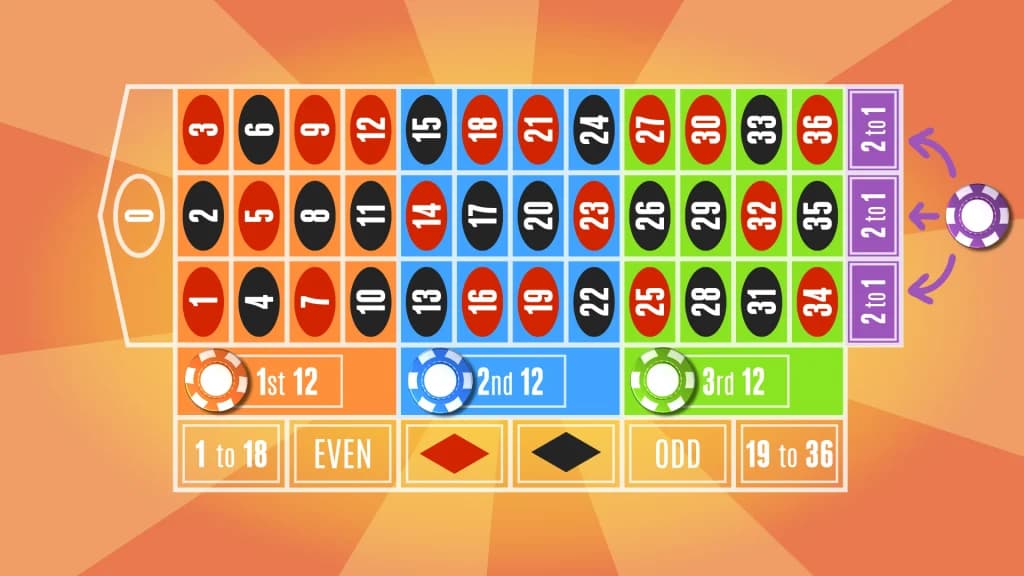
Dozen and column bets each cover 12 numbers. They have identical odds and payouts. However, when looking at a roulette table, their placements are different.
There are three dozens that cover the first, middle, and last 12 numbers.
- 1st Dozen: numbers 1 – 12
- 2nd Dozen: numbers 13 – 14
- 3rd Dozen: numbers 25 – 36
To bet on them, you place your chips on the marked rectangles (labeled 1st 12, 2nd 12, and 3rd 12), located in the outside bet area.
There are also three columns, covering 12 numbers that follow a straight vertical line.
- 1st Column: 1, 4, 7, 10, 13, 16, 19, 22, 25, 28, 31, 34
- 2nd Column: 2, 5, 8, 11, 14, 17, 20, 23, 26, 29, 32, 35
- 3rd Column: 3, 6, 9, 12, 15, 18, 21, 24, 27, 30, 33, 36
To bet on one of the columns, place your chips on the square at the end of the vertical line, labeled “2 to 1.”
Dozens and columns cover the same amount of numbers and thus have the same exact chances of winning. So for any of the dozens strategies you’re about to see, you can swap the dozens for columns and get the same odds. Pretty nifty, right?
Now the question is: how do you use the dozens as a proper roulette strategy? Great question. Let’s get into it.
Single Dozen Strategy
With the single dozen roulette strategy, you focus your bets on one dozen. Pick any one. No! Not that one! Just kidding. That one’s perfect.
Now, you’re going to follow a negative progression. That means that each time you lose, you’ll advance one number in the sequence. And the sequence is:
1, 1, 2, 3, 4, 6, 9, 14, 21, 31, 47, 70…and so on.
At first, it appears similar to the Fibonacci sequence, which also happens to be a very popular roulette strategy. But while this sequence doesn’t result in nature’s perfect spiral pattern, it also works as a slow and gentle progression, but without the backsliding of the Fibonacci.
To use it, you place a bet on your preferred dozen and keep your bet there for the entire strategy.
Each number in the pattern stands for your betting units. Each time you lose, you move forward one sequence in the pattern and bet that number of units.
So if you start with $1 units and lose on the first number (1), you bet $1 again. If you lose on that number, you now bet $2. If you lose, you bet $3, and so on. The pattern could theoretically go on forever, but we sincerely hope the ‘70 and beyond’ numbers are theoretical only. Here’s to hoping we never get there.
Double Dozen Strategy
The single dozen roulette strategy covers 12 numbers and has a 31.6% to 32.4% chance of winning, depending on whether you’re playing American or European roulette.
If you want an even higher chance to take home the bag, that’s when you might consider the double dozen strategy.
Now, instead of betting on one dozen or column, you’re covering two. That means 24 numbers, and a 63.1% to a 64.8% chance of winning.
The sequence this time looks different:
1, 3, 9, 27, 81…
You’ll still increase your bet after each loss. But now, your bets are tripled. And that’s not fun and exciting like a triple berry pie. It’s more like a triple parking ticket. Or the Martingale on some very illicit substances that we won’t be mentioning here.
If you start with $1, your first loss means you now bet $3. If you lose again, you bet $9, then $27, then you’re up to $81, and so on. The exponential upward slope is designed to recover losses faster.
But the good news with the double dozens is that you’re covering more than half of the wheel, so you have pretty good chances of winning. Still, never count on a loss progression strategy to get the job done for good. One big losing streak, and you’re wishing you had a few of those triple berry pies to soothe the pain.
The Drawbacks

As we already mentioned, the biggest bummer when it comes to the dozens and double dozens roulette strategies is the same as any other progression strategy. Eventually, you’ll either wipe out your bankroll or hit the table limit and kiss your (now very steep) losses goodbye.
Negative progression systems sound good in theory, and often they are. But they only work if you start with smaller bets, then get lucky early in the sequence to recover your losses, as we learned from using the Martingale system.
But just as you’ve experienced an epic win streak, you can also experience an epic losing one, and that’s where the dozens strategy gets you in trouble.
Dozens Bet Odds, House Edge, And Payouts
Just one column or dozen (12 numbers) has a 31.6% chance of winning on American roulette, and a 32.4% chance of winning on European roulette. Both pay 2:1.
In practice, if you put $10 on the first dozen and win, you’ll receive a $20 profit, done and done.
Now let’s look at the double dozen. The results are surprising.
Payout for the Double Dozens
When you add another column or dozen, you cover 24 numbers. That boosts your chances to 63.2% on the American wheel and 64.9% on the European wheel. So you would think you’d be profiting more, right? But that’s not how roulette works.
The more you cover, the less you win. And that’s the story of roulette.
When you win a double dozen bet, regardless of where you are in the sequence, you would receive a 2:1 payout for the winning dozen. But then, don’t forget that you must subtract your bet from the losing dozen, which means, in reality, you’ll only profit 1:1.
Let’s look at an example.
- You bet $10 on the first and second dozen.
- You win on the number 7, which falls within the first dozen.
- Your payout is 2:1 ($20)
- Now, you must subtract your losing bet from this profit, which was $10.
- The result is a $10 payout, the same as if you’d simply been paid 1:1.
The Bottom Line

The single dozen bet in roulette pays 2:1, roughly 32% of the time, and progresses slowly on your losses. The double dozen bet pays 1:1 roughly 64% of the time and uses aggressive progression to recover. Neither strategy will beat the house edge, but both are worth a shot.
Pull up a chair at Cafe Casino, and when the waitress asks you, “What’re you havin’?” You can say: “I’ll take a dozen… actually, make it two.”