
Hit or Split: Do You Split Twos In Blackjack?
When you sit down at the blackjack table and peel back a pair of 2s, it’s a small, weak hand – the ‘terrible twos,’ if you will. Your first instinct is usually to hit, and you’re not wrong. Most of the time, those tiny deuces need a little help before they grow into something respectable.
But every now and then, the game hands you one of those rare moments where splitting is the better choice.
When the dealer’s upcard lines up just right, splitting those 2s gives you a better long-term outcome than building with a single hit. So, do you split twos in blackjack? You don’t do it often, but when the conditions are right, you absolutely should, and we’re about to show you when.
Why split twos?
Splitting 2s isn’t something you do often, so when the chance shows up, it helps to understand why it works.
A pair of 2s starts as a weak hand. You’re sitting on a total of 4, which isn’t exactly intimidating to a dealer holding anything decent. Hitting usually makes the most sense because you need to build something – anything! – that puts pressure back on the dealer. But splitting is helpful under certain circumstances.
The whole point of splitting 2s is that sometimes two small hands have a better long-term expectation than one shaky hand, i.e., a four.
When the dealer shows a 4, 5, 6, or 7, they’re more likely to bust. That’s a window for you to create two hands. It gives you twice the potential to catch strong draw cards, like a 9 that shoots one of your hands up to an 11. And if doubling after a split is allowed, that option becomes even sweeter because you can press the advantage on both hands if the draw cooperates.
Let’s break down the details on how to manage a pair of twos.
Pair Of Twos Strategy if Doubling Down is Allowed After Splitting (DAS)
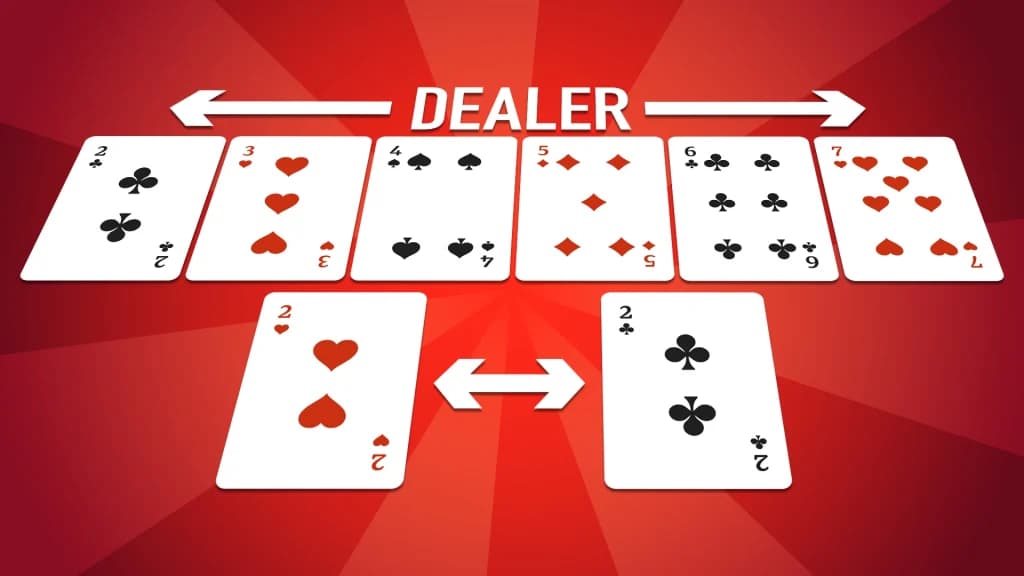
Quick Answer:
- Single, Double, or Multi-Decks DAS: split a pair of twos if the dealer shows 2 through 7. Otherwise, hit.
When blackjack variation lets you double down after a split (called DAS, for those not familiar with blackjack slang), your pair of 2s has way more potential.
In DAS games, you split 2s against the dealer’s 2 through 7, regardless of whether it has single, double, or multi-decks. Why? Because doubling down after the split lets you take full advantage of any strong follow-up card, and 2s have a knack for quick improvement.
For instance, if you do the split and a 9 drops on one of your new hands, you’re now holding an 11. That’s a prime opportunity to double because the deck is richer in 10-value cards, and you might score a blackjack. That opportunity didn’t exist when you kept them together.
Pair Of Twos Strategy if Doubling Down is Not Allowed After Splitting (NDAS)
Quick Answer:
- Single Deck NDAS: split 2s against a dealer’s 3, 4, 5, 6, or 7. Otherwise, hit.
- Double or Multi-deck NDAS: split 2s against a dealer’s 4, 5, 6, or 7. Hit on everything else.
When the casino shuts down your ability to double after a split, first off, how rude (any Full House fans here?). Second, there’s a strategy for that.
In these games, you only split your 2s when the dealer’s upcard is weak enough that two fresh starting hands still beat taking a single low-value draw.
In a double- or multi-deck NDAS game, basic strategy tells you to split only against a dealer 4, 5, 6, or 7. Those dealer upcards stumble often, and two new hands give you a better long-term return than trying to hit your way out of a 4.
For single-deck games, you can add a dealer’s three to the lineup, meaning you split on 3 through 7.
On anything else, you hit. Your expectation stays negative no matter what, but hitting loses less money over time than splitting when the dealer is showing strength or even mild stability.
Splitting 2s Example With Single Deck Blackjack
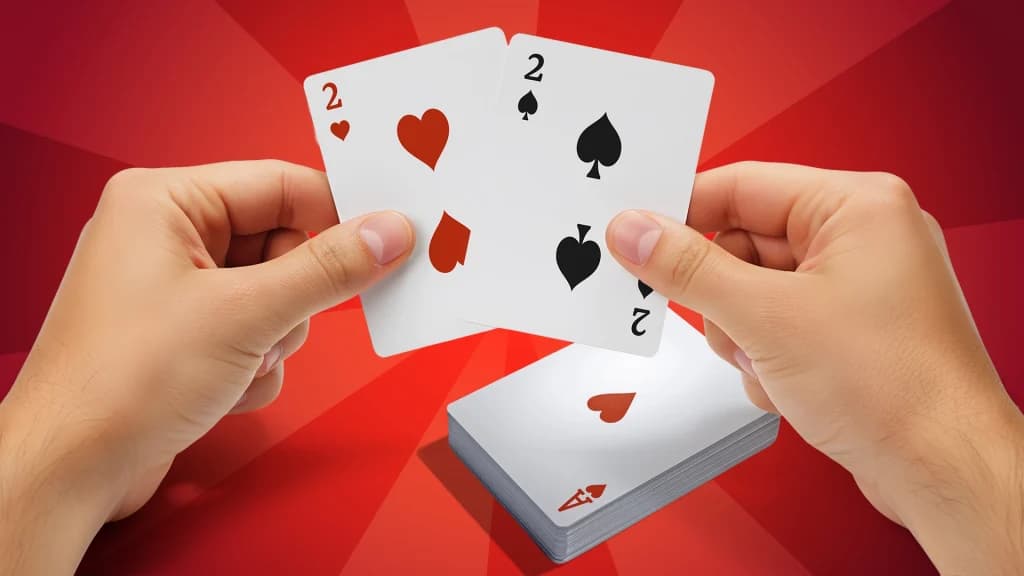
Let’s say you’re single-deck blackjack today (Hi, Single-Deck Blackjack, I’m Dad). In this case, the rules are a bit different for your pair of 2s.
Imagine the dealer flips over a 6, and you peel back 2-2. With a single deck, basic strategy tells you to split here, because splitting gives each 2 a fresh start against one of the weakest dealer upcards you’ll ever see.
You with us? Great.
Now, your first split hand pulls a 9. That gives you 11, which is one of the best totals you can ask for because you can double down (if the rules allow it) or at least hit with strong odds. Your second split hand might catch a 7, giving you 9, which is still an easy hand to build on without risking a big bust.
But let’s flip the scenario. You’re still playing with a single deck, but this time, it has NDAS rules. You get 2-2 against a dealer 9. Here, strategy tells you to hit, not split. With a 9, the dealer could easily reach 19, and you’ll have to hit aggressively to catch up. Neither option is a sure thing, but you’ll lose less on average by building one hand instead of trying to create two weak ones.
To recap, you mostly hit a pair of twos, but you split when the dealer’s upcard is 2 through 7, and the table lets you double after splitting. In that way, these small twos really aren’t as terrible as you might think. If you want to put these moves into practice, grab a friend, pull up a seat, and play blackjack at Cafe Casino as a duo. But you’d better be on your best behavior, otherwise, we’ll split you up.