
Do you split 8s in blackjack? SPOILER: Always
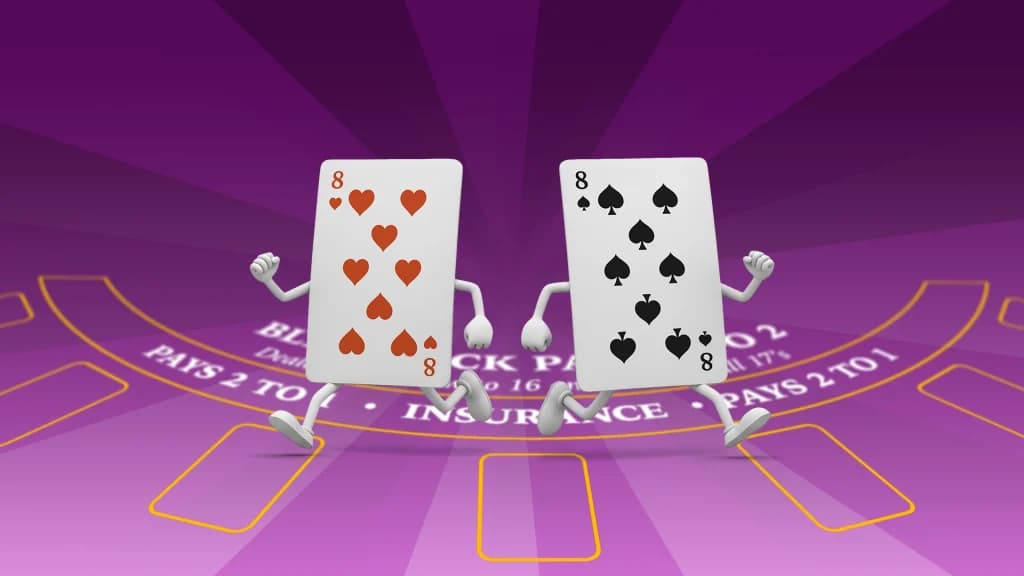
Life is full of hard choices. Choosing a major. Picking tonight’s restaurant. Or worse, debating whether to eat those leftovers. But splitting 8s in blackjack? Now that’s an easy one. You split. Badabing, badaboom. Finally, some easy choices in life!
Splitting 8s gives you two fresh starts instead of one doomed total of hard 16 (cue the horror screams), and the support behind it dates back decades. From the Four Horsemen to Ed Thorp’s computer-backed strategy charts, every expert agrees you gain more by splitting than standing still. We’ll show you why and what to do in specific situations.
When should you split 8s in blackjack?
We’ll make this nice and simple. You always want to break two 8s apart, KitKat-style, to form two better hands. Just don’t bite down the middle. That’s unhinged behavior, and we won’t have that here.
The reason is that splitting your 8s is a gift when faced with a hard 16 (a blackjack soft 16 is another story). That’s particularly true when the dealer has an upcard of 7, 8, 9, 10, or ace, which are strong cards. The dealer is likely to draw a 10 and stomp on your weak 16. But the road goes both ways.
If you split, you also have a solid chance of drawing a 10-card on one of your 8s – a roughly 33% chance, to be exact. That would bring your total to a strong 18, which is a hand we love to see, and one that has a fighting chance against a 7, 8, 9, 10, or ace.
But wait… what happens if the dealer shows a weak card, like a 2 through 6? Do you split 8s in blackjack then? Yep! Don’t even doubt it. It’s still better to avoid the 16 trap and have two additional chances to land a 10-value card and form 18. That’s why you always split 8s in blackjack, regardless of what the dealer shows.
The History of Splitting 8s
How do we know with such confidence that you should always split 8s in blackjack? This move stretches back long before strategy charts lived in everyone’s screenshot album.
In the 1950s, four math-loving legends known as the Four Horsemen sat down with nothing but manual calculators and a mission to decode every possible blackjack outcome. They were really fun at parties.
After crunching thousands of combinations, these math wizzes discovered that keeping a hard 16 was a disaster, and splitting 8s consistently lost less money in the long run. Players doubted them at first because blackjack “wisdom” at the time was mostly superstition and guessing.
Then, in the 1960s, Ed Thorp arrived with an IBM computer and confirmed their work down to the decimal. His book Beat the Dealer turned the idea mainstream and cemented splitting 8s as a core strategy. Ever since, every serious blackjack chart, expert, and simulation has backed the same advice to split your 8s.
Should you ever not split 8s?
Ssshhh. The Four Horsemen can hear you.
Splitting in blackjack can be confusing, so if you don’t want to complicate your life, we can just say no, you should never not split 8s. However, if you’re the type of person who reminds your boss about the meeting he clearly forgot, you could keep your 8s together if you’re playing defense.
An example is if the dealer shows a 10 or an ace. They’re in a strong position with these cards, and they’ll likely get a shiny high hand. You have a lame 16, and your split isn’t guaranteed, so why risk more money if you’ll lose anyway? It’s a valid point, and no one would blame you for avoiding the Great Split.
However, if you do pull them apart against a dealer’s 10 or ace, you’re playing to win, not to lose politely. In the long run, splitting your 8s and giving two new hands a shot is a solid tip that will save you money.
Should I ever surrender with a pair of 8s?
No way, Jose! If you surrender your pair of 8s, then it’s no more KitKats for you. But seriously, jokes aside, you would rarely do it. You now have two chances to build an 18. After you split, there’s a roughly 33% chance of pulling a 10 or face card, which is a higher chance than drawing any other card. Surrendering just doesn’t make sense. Unless…we did say ‘rarely’ and not ‘never,’ right?
You only ever surrender a pair of 8s in one very narrow situation. Check both of these boxes:
- The dealer shows an ace or 10
- The blackjack variation offers early surrender
If all of those factors are true, then yes, surrendering is the stronger play. That’s the only time basic strategy gives you the green light to walk away. Because in that exact situation, every option you have is terrible, and surrender simply loses the least amount of money in the long run. This is why.
A pair of 8s gives you a hard 16, which, as you know, is already one of the worst totals in blackjack. When the dealer shows a 10 or an ace, their final hand is strong on average, and your chances of winning even one hand after splitting are extremely low.
In this situation, hitting a hard 16 loses more money over time. Standing loses even more. It’s like choosing between the middle seat on a six-hour flight or the bathroom aisle seat that doesn’t recline. So what’s a player to do? Say, ‘eh,’ throw in the towel with a surrender, and try to disassociate with your headphones on. Next!
Life is full of hard choices, but at least splitting 8s is an easy one. When you know to always split 8s, you’re snapping decisions cleanly, just like a KitKat bar broken the correct way (don’t disappoint us). Take this strategy to the Cafe Casino blackjack table and win more in the long run. That way, once you make smart choices and win, we can tell everyone that this player ate.